

 USA TODAY National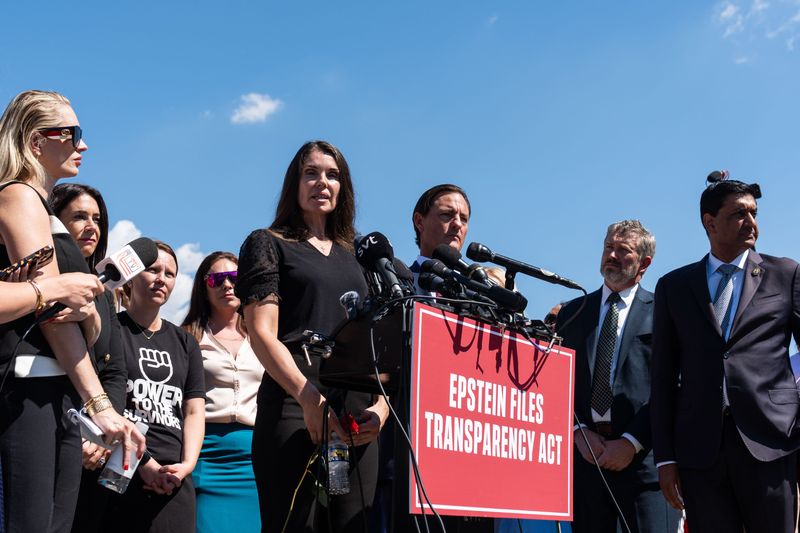
Jeffrey Epstein victimized at least 1,000 women and children, the Justice Department says. His survivors don't want that to be forgotten.
“I am one story of a thousand," said Danielle Bensky, who said she was 17 when she met Epstein in 2004. "Think of that number: 1,000.
“We are a representation of women across America," she said at a news conference Nov. 18. "We come from different backgrounds, we have different religions, we are different races, different creeds, different ethnicities, we have different political affiliations.”
Between a federal indictment, a police investigation, civil lawsuits and public allegations, Epstein is accused of running an international sex trafficking ring that recruited more than 1,000 girls as young as 14 to have sex with him, his associate Ghislaine Maxwell and other men.
Women have said they were abused all over the world ‒ in California, Florida, New Mexico, New York, Ohio, the United Kingdom and the Virgin Islands ‒ often under the guise of providing massage services to earn extra money or getting help with their modeling careers from a well-connected man.
Some of the accusers say they contacted the FBI and local police in the 1990s but weren't taken seriously.
Six years after Epstein's death, hundreds of women, who call themselves Survivor Sisters, became the driving force behind the renewed public pressure to identify Epstein associates they say assaulted them or participated in his trafficking ring.
Their advocacy pushed the House and Senate to vote to demand the release of the Justice Department's investigative files into Epstein. But in the months leading up to the vote, the topic increasingly turned into a political bludgeon and partisan blame game.
President Donald Trump pressured Republicans not to join the effort to produce the documents, referring to it as the "Epstein hoax" and calling a Republican who wanted to release the records a "traitor." He abruptly turned to support the measure when it was clear it would pass. Trump signed it late Nov. 19.
The survivors who have come forward say they are infuriated that their trauma was used for politics and that what they experienced was diminished.
“None of us here signed up for this political warfare. We never asked to be dragged into battles between people who never protected us in the first place,” Wendy Avis said at a news conference before the Nov. 18 votes. “We are exhausted from surviving the trauma and then surviving the politics that swirl around it.”
'I’m not sure if anybody knows the exact number'
Only a couple of dozen Epstein accusers have ever spoken publicly about their experiences, and they say fears of retribution and attacks on their careers and families have kept them from doing so before.
But more women are coming forward by the day, and they have told their stories publicly in an effort to get the files released.
That includes an emotional public service announcement video released shortly before the House and Senate votes, urging Americans to call their representatives to release the Epstein files.
Marina Lacerda, who said she was 14 when she met Epstein, told her story for the first time outside the Capitol on Sept. 3. Lara Blum McGee, who said she was lured into Epstein's world through modeling, said at a news conference Nov. 18 that it was her first time speaking publicly.
In a memo in July 2025, the FBI said its review of the files found that Epstein's victims numbered more than 1,000.
Gloria Allred, an attorney representing some of the survivors, said at a news conference Nov. 17 that accusers want the files released in part because they don’t have the whole picture of what happened. Instead, they know only what they've been able to cobble together from those who have come forward.
“I’m not sure if anybody knows the exact number,” she said.
Survivors who came forward in the 1990s were often ignored, threatened with damage to their careers and encouraged not to file police reports, testimonials and evidence suggests.
Annie Farmer, who was 16 when she met Epstein, said her older sister Maria Farmer, who was also a victim of Epstein, was dismissed by the FBI when she called in 1996.
"They hung up the phone on her, and there was no follow-up of any kind," she said. The FBI contacted the sisters in 2006 to be witnesses against Epstein but again never followed through, she said.
Maria Farmer has sued the FBI, seeking to hold the agency accountable for not investigating her claim more thoroughly.
The Palm Beach Police Department in Florida first started investigating Epstein in 2006, an effort that ended in a sweetheart nonprosecution agreement in 2008 that exempted Epstein from being charged with the most severe allegations against him.
Virginia Roberts Giuffre, who said Epstein raped and trafficked her from 2000 to 2002, was the most outspoken person to tell her story. She sued Epstein in civil court in 2009 under a pseudonym and shared her name publicly in 2011. Before her death by suicide in April, she had taken Maxwell and the former Prince Andrew to civil court.
Sky Roberts, her brother, said justice starts with acknowledgement.
“Acknowledge in the face of survivors that this happened,” he said at the Nov. 18 news conference. “These survivors are not political tools for you to use. These are real stories, real trauma, and it’s time for you to stop just talking about it and act.”
Teresa J. Helm told USA TODAY she hopes the files will provide new information on the people who were engaged in sex trafficking with Epstein and Maxwell, as well as the people who profited or benefited from it in some way. She says she was assaulted by Epstein in 2002 at what she thought was a job interview.
"I do think it's important for people to know, because ... knowing what he did is knowing what everyone else did alongside of him," Helm said.
Too many powerful people involved are living with impunity, carrying on with their lives and their businesses while hundreds of women "have had to rebuild their lives," she said.
"I think we're all willing to keep speaking and pushing and taking all the steps necessary to try to get through the political theater, get through the saga series of the Epstein files and all of that. But what we need is … further investigation," Helm said.
'Impossible to ignore'
The survivors are still finding one another, Helm said.
"For 17 years I thought I was the only one," she said.
As much as they want justice for themselves, they want to change a justice system they say failed to protect them as children and young adults.
"The truth is simple: We were victimized as children and failed repeatedly by the very system that was supposed to protect us," said Ashley Rubright, who met Epstein when she was 16. "The Epstein case was gravely mishandled, consistently and deliberately over many years. Epstein could have been stopped decades ago."
Some survivors are still afraid to come forward, Rubright said. And some of those who spoke up have been flooded with threats.
Rubright said she didn't plan to speak at the Nov. 18 news conference, but she stepped in when another accuser who has repeatedly told her story said she couldn’t come because of threats she has received.
“When you threaten one of us, you’re threatening all of us. We are together now, and that’s never going to change,” she said.
Rubright said survivors have dealt with years of civil cases landing before hostile judges, delay tactics, intimidation and public relations campaigns “designed to smear us in the public eye.”
When law enforcement was first investigating Epstein in the mid-2000s, accusers said, Epstein's lawyers dug up dirt on them and accused them of being prostitutes. Alan Dershowitz said in the 2019 documentary "Surviving Jeffrey Epstein" that a criminal defense lawyer's job is "to get the best result you can get ethically and legally" and called it "completely appropriate to investigate complaining witnesses."
“We were treated as problems to be managed, instead of victims to be protected,” Rubright said.
But now that so many have found one another, they are done being dismissed.
“Individually, our voices were whispers. Together, they’ve become impossible to ignore,” she said.
Making their own Epstein files
Lisa Phillips, who said at an earlier news conference that survivors would compile their own list of people involved with Epstein if the administration does not release the files, said Nov. 18 they’ve begun working on it and have been approached by new women across the country.
“More survivors across the country and around the world have reached out, texts, emails, DMs, firsthand accounts and evidence,” she said. “Many are still terrified to speak publicly, because the men involved are powerful. They’re connected, and as we know, they are protected.”
But decades after their abuse, many survivors are no longer willing to wait for permission to speak about what happened, she said.
“The survivors now coming forward have entrusted us with their stories. We are sharing that information with the proper authorities, and when it can be safely made public it will be.”
Phillips told CNN Nov. 19 that survivors want the files to help build a complete picture of what Epstein was able to do to 1,000 women and children over several decades and at multiple locations in the United States and overseas.
"We’re still, even up to every time that we come together, finding out more information and a new survivor comes forward has a picture of us from that time. And so it’s just a confusing thing for us collectively. We want the files … just to know our complete story.”
Sarah D. Wire, a senior national correspondent for USA TODAY, can be reached as swire@usatoday.com.
This article originally appeared on USA TODAY: Jeffrey Epstein victimized 1,000 women and children. His survivors have a message.
Reporting by Sarah D. Wire and Erin Mansfield, USA TODAY / USA TODAY
USA TODAY Network via Reuters Connect

 Associated Press US News
 Raw Story
 AlterNet
 CNN
CNN The Conversation