

 AlterNet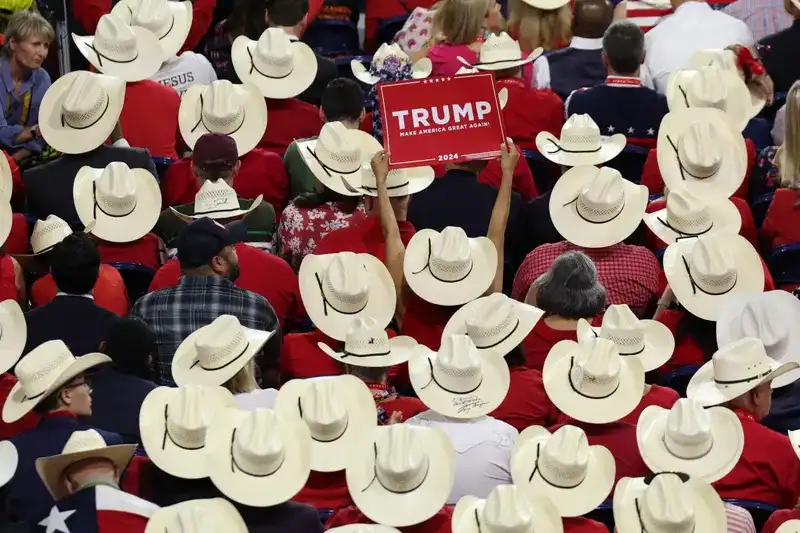
In an episode of The New York Times podcast “The Opinions," opinion editor Meher Ahmad, columnist and sociologist Tressie McMillan Cottom and photo editor and creative consultant Emily Keegin discuss how, thanks to MAGA, "country and cowboys have a hold on our culture and our political imagination."
"Rural aesthetics are in, from cowboy boots to country albums by pop stars to pastoral idealism peddled by influencers," they explain.
The "ongoing mainstreaming of all things country and rural" can be seen in popular shows like "Yellowstone" and "The Hunting Wives," or in the music of Beyoncé and Sabrina Carpenter.
As for the popular Montana ranch drama "Yellowstone," McMillan Cottom says, "What Taylor Sheridan was right on time with is: He produced a soap opera for Trump’s America with all of its anxieties. And yes, this is the idea of the dangerous 'others' coming from outside the country."
"Tradwife influencers like Hannah Neeleman, popularly known on social media as Ballerina Farm, has now more than 10 million followers," they note.
Keegin says she noticed an uptick in the country aesthetic as soon as President Donald Trump won a second term in 2024.
"And after the second Trump win, what I noticed was there was a big cowboy trend that took off. Denim is big. Western culture is big," she adds.
In response to Ahmad asking if the trends have political undertones, McMillan Cottom says "Trends are trends," but "yes, the cultural turn is mirroring the political turn."
"When we’re talking about being romantic for rural life, we’re really talking about an imaginary place. This isn’t really the rural life that actual people who live in rural America tend to be familiar with," she explains.
McMillan Cottom also says that the trends are echoing a certain type of nostalgia that is the antithesis of fashion—or anything, really—forward moving.
"When you say something like 'Make America Great,' that’s a backward-looking vision. That is not about the future — although it’s trying to own the idea of what the future should look like," McMillan Cottom explains.
"It is really calling to a nostalgia for an imagined American past where all families were 'traditional' and all women were real women and home life looked this way," she adds.
As for Trump being a New York City and urban icon, McMillam Cotton says it's not so.
"I would say that what Donald Trump does — the way he enters into the rural imagination: He does it through Southernness," she explains.
"I think that what Donald Trump does is he becomes associated with rural life because of how often he has appealed to Southernness, when he, of course, raises the specter of racism or raises the specter of genteel womanhood — all of those things that the South is kind of known for," she says.
While Trump's rhetoric hasn't sparked a "Confederacy chic movement, per se, it is popular among the MAGA set," McMillan Cottom says.
"You can pull out the Confederate flag, and you can pull out songs of the South or whatever it is," she adds. "I’d pay money to see Donald Trump in actual rural America, for what it’s worth."
Keegin says that the reason Trump can pull off this rural facade is because he's not as urban as he thinks he is.
"When I look at Trump, I think: Yes, there are a lot of things about him that are very rural — because he’s not slick," she says, as compared to California Governor Gavin Newsom (D), whom McMillan Cottom describes as the "quintessential urban guy."
As for what the next political aesthetic will be, McMillan Cottom looks more towards the homegrown, crafty type.
"Something needs to resonate with voters that there is something real there — even if it is constructed. We want the Etsy candidate, y’all," she says.

 The Conversation
 @MSNBC Video
 Cleveland Jewish News
 The Fashion Spot
 New York Magazine
 Breitbart News
 Raw Story
 The Danville Register & Bee Entertainment