

 USA TODAY National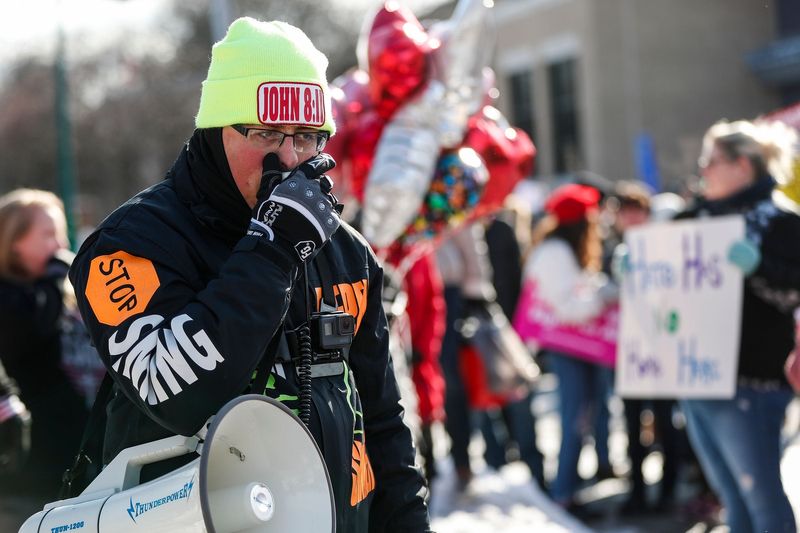
WASHINGTON – The city amphitheater in a suburb of Jackson, Mississippi, attracts thousands of concertgoers – and also evangelical Christians like Gabriel Olivier, who frequent the venue hoping to share their faith.
But officials in Brandon, Mississippi, said the messages Olivier and others in his group spread – including shouting insults such as “whores” and “Jezebels” over a loudspeaker and holding up large signs of aborted fetuses – were too disruptive.
The Supreme Court on Dec. 3 will consider whether Olivier, who was arrested for refusing to remain within the city's designated area for protests and demonstrations, can sue the city for restricting his exercise of religious freedom.
Is the case about religious freedom?
Olivier hopes to sway a conservative court that has largely been sympathetic to allegations about burdens on religious rights. He argues the First Amendment’s guarantee of religious liberty is meaningless if he can’t challenge the city's restrictions.
City officials counter that the rules aren’t specific to religious activities and Olivier is improperly trying to get into federal court even though he didn't contest his conviction for violating the city's ordinance in state court.
If the Supreme Court allows Olivier’s challenge to proceed, they argue, it would open the door to allowing someone accused of a crime to plead guilty to avoid jail time and then turn around and sue.
Olivier “wants this case to be about religious liberty,” the city’s lawyers said in a written filing. “It’s not.”
Street preacher rejected designated protest area
There’s no dispute, however, about what led to the challenge.
Olivier's group preferred to preach at the amphitheater's main intersection, which city officials said made it hard for traffic cops to hear radio traffic. People attending concerts walked in the street to avoid the proselytizing and officers had to leave their posts to prevent fights from breaking out, according to city officials.
After the city of Brandon approved new restrictions on where demonstrations could take place, Olivier and others in his group went to the amphitheater in 2021 on the night of a country music concert.
Handed a copy of the rules, Olivier checked out the designated protest area – and rejected it.
“He quickly surmised it was just completely unworkable from what he wanted to do because it separated his message from his intended audience,” Nathan Kellum, a lawyer with the First Liberty Institute who is representing Olivier, said in a virtual discussion of the case hosted by the Federalist Society. “And that seemed to be the whole idea behind the law in the first place.”
After refusing to follow the rules, Olivier was arrested.
He was fined $304, given a suspended sentence of 10 days in jail and a year on probation.
Rather than contest his conviction, Olivier used a federal civil rights law to sue the city, arguing his constitutional rights had been violated.
Lower courts ruled against street preacher
A federal district judge threw out the suit. That decision was backed by the New Orleans-based 5th U.S. Circuit Court of Appeals, which cited a 1994 Supreme Court ruling that a convicted criminal seeking damages for an allegedly unconstitutional conviction must exhaust state court remedies before bringing a federal suit.
Olivier argues his situation is different because he’s dropped his claim for damages and only wants to prevent the city’s rules from being applied to restrict his conduct in the future.
The Justice Department has weighed in on his behalf, as have several religious organizations, including the Hare Krishna movement.
The International Society for Krishna Consciousness said they face a no-win situation because groups like theirs – “which must disseminate or perform their religious convictions in public” – are most likely to need to challenge restrictions similar to Brandon’s but are also the most likely to have already been charged with violating them.
Another member of Olivier’s group, who was not arrested, also challenged Brandon’s rules in a separate lawsuit.
The 5th Circuit Court of Appeals last year rejected that attempt to block the rules, saying the restrictions are not aimed at religious speech and are narrowly tailored to protect public safety and control traffic.
This article originally appeared on USA TODAY: A screaming street preacher gets hearing at Supreme Court
Reporting by Maureen Groppe, USA TODAY / USA TODAY
USA TODAY Network via Reuters Connect

 America News
 Local News in California
 Local News in Pennsylvania
 The Atlantic
 Associated Press US News
 Reuters US Politics
 Local News in Florida
 AlterNet
 The Boston Globe Crime