

 Reuters US Top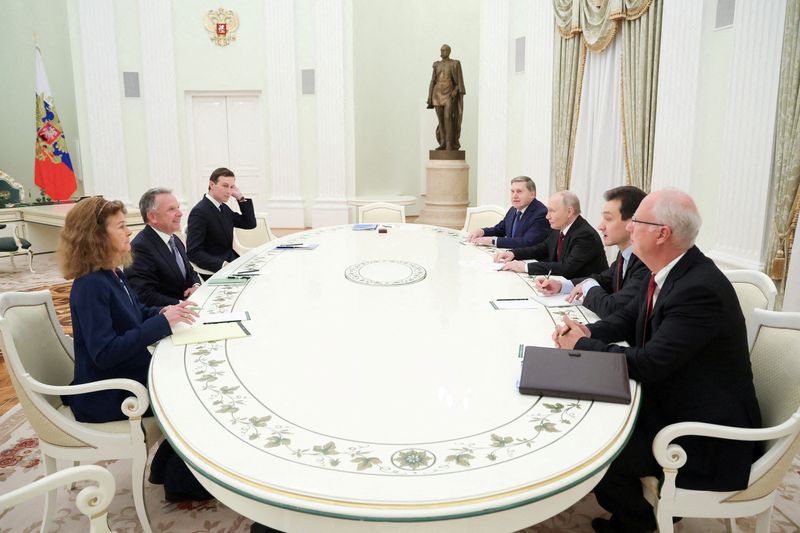
By Simon Lewis and Gram Slattery
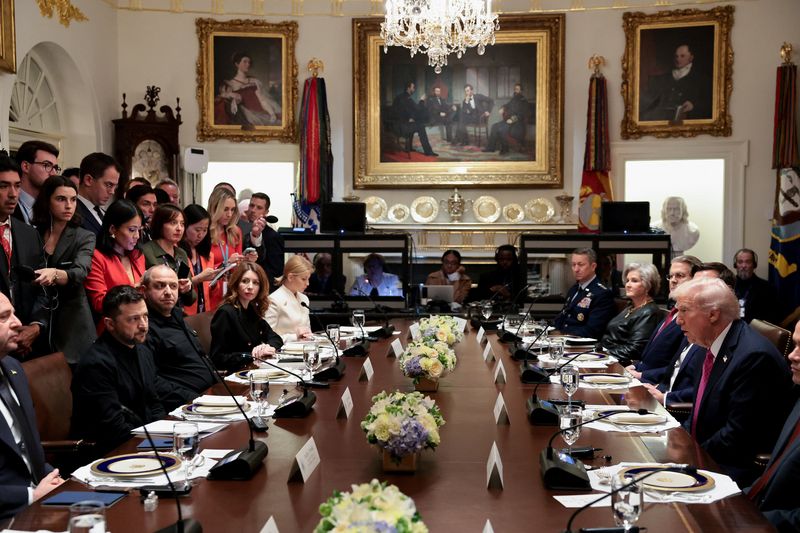
WASHINGTON, Dec 3 (Reuters) - The confusion still swirling in Washington over President Donald Trump's latest peace plan for Ukraine has made at least one thing clear: The U.S. president's unconventional, all-in approach to diplomacy carries big risks - both domestic and geopolitical - as well as potential rewards.
The Russia-friendly peace plan that emerged two weeks ago bore many of the hallmarks of Trumpian diplomacy visible in crises from Gaza and Iran to Venezuela.
It came as a surprise, demanded painful concessions from the parties involved, set a short deadline and featured freelance diplomacy by officials willing to overlook the concerns of traditional policy experts and senior figures in Trump's own Republican Party.
Above all, Trump put himself in the middle, opining on social media and throwing his support behind the plan.
That approach has yielded some successes, most notably a ceasefire in Gaza that eluded Trump's predecessor Joe Biden. But so far, the unexpected plan to end the war in Ukraine - and revelations that Russian officials had a hand in its creation - has stirred harsh criticism from Republican lawmakers, exasperation from European allies and confusion inside the administration.
And it carries political danger for Trump, said Republican strategist Alex Conant. The president's political base has strongly backed him so far, but with worries rising about the U.S. economy, voters could see him as deeply involved in overseas crises at the expense of concerns at home.
POLITICAL RISKS AT HOME
Trump's approval rating last month fell to 38%, its lowest point in his second term, according to a Reuters/Ipsos poll, reflecting cost-of-living concerns at home. He also has weathered criticism from ardent supporters, including one-time ally U.S. Representative Marjorie Taylor Greene, who criticized Trump for abandoning his America First agenda to focus on foreign policy matters. She subsequently announced her resignation last month.
"He's taking risks in the hopes of historic rewards. That's classic Trump - Trump's always been a risk taker," said Conant, a former senior campaign adviser to Marco Rubio, who is now Trump's top diplomat. But, Conant added: "The more involved he is, the more he owns it."
In response to a request for comment from the White House, a senior U.S. official said Trump was able to deliver for Americans on economic issues as well as working to end wars.
"It was a campaign promise to end these wars. He's delivered on the Israel-Gaza war, which is something that is a tremendous accomplishment. A lot of people thought it couldn't be done. The president did it," the official said.
A late-night meeting about the Ukraine peace plan on Tuesday involving Russian President Vladimir Putin and Trump envoy Steve Witkoff produced no breakthroughs.
'OVERTURNING THE TABLE'
The latest Russia-Ukraine proposal was developed far from Washington and without the experts who have traditionally shaped U.S. foreign policy.
Witkoff and Russian envoy Kirill Dmitriev largely forged the plan during an October meeting in Miami that included Jared Kushner, Trump's son-in-law. Axios' November 18 report on the 28-point plan was the first the public, and many inside the Trump administration, knew of it.
Witkoff, a New York real estate magnate and longtime friend of Trump, has taken a leading role in negotiating several major conflicts despite having little diplomatic expertise.
The senior U.S. official said the Trump administration's use of outsiders like Witkoff had proven successful with the Gaza deal, and said Washington foreign policy experts had a record of failure.
The Gaza deal has brought a relative calm to the Palestinian enclave but has not resolved some crucial issues, such as the disarming of the militant group Hamas.
The Ukraine peace plan, for its part, met push-back from European leaders, who were alarmed by its initial endorsement of Russian demands that Ukraine give up more territory, curb the size of its army, renounce joining NATO and be barred from hosting Western troops.
Many in Europe see the danger as existential. They fear that ending the war on Moscow's terms and canceling sanctions will give Moscow billions of dollars to reconstitute its military.
Some U.S. foreign policy experts say the traditional negotiating process, however, stifles decisive action and merely prolongs a war that has killed hundreds of thousands of soldiers and destabilized Europe.
Veteran U.S. diplomat Dan Fried said that, while allowing the Kremlin to set the parameters of the Ukraine negotiations could prove a major mistake, a workable deal could still emerge.
"Sometimes throwing things up, overturning the table, can be useful," said Fried, who worked in both Republican and Democratic administrations and is now at the Atlantic Council think-tank. "And Trump has got everybody now thinking about what a plan would look like."
FRICTION AND CHAOS
That disruptive style has introduced friction and some confusion into U.S. foreign policy.
Many senior officials inside the State Department and on the National Security Council were not briefed on the Russia-Ukraine plan until it was reported in the press, sources familiar with the plan said.
The acting U.S. ambassador to Kyiv, Julie Davis, who had only just learned about the plan herself, was instructed by the White House to brief Army Secretary Dan Driscoll on it shortly before his talks with Ukrainian officials, according to two sources familiar with the matter.
Driscoll was in Kyiv for talks not focused on the peace plan but pivoted to presenting the plan to the Ukrainians, a U.S. official said.
The U.S. Army referred questions about Driscoll's efforts on Ukraine to the White House. The White House did not directly respond to questions about Driscoll's meeting in Kyiv but the senior U.S. official said the process of formulating the Ukraine plan was "not chaotic at all, it was quite seamless." The plan was discussed by Witkoff, Rubio and Vice President JD Vance and then signed off on by Trump, the official said.
Emma Ashford, a senior fellow at the Stimson Center think-tank in Washington, said that with Ukraine experts sidelined, diplomacy initially focused on Ukraine's rare earth minerals and the involvement of business deals that distract from the core dispute between Ukraine and Russia.
"It's taken them a very long time to get to the crux of some of these issues," Ashford said, adding that the U.S. approach had also left partners confused about which U.S. official is presenting the true U.S. position.
(Reporting by Simon Lewis and Gram Slattery; Additional reporting by Humeyra Pamuk and Idrees Ali; Editing by Don Durfee and Edmund Klamann)

 Chicago Tribune
 America News
 Associated Press US and World News Video
 Reuters US Business
 KCRA News
 WAND TV
 Raw Story