

 The Atlantic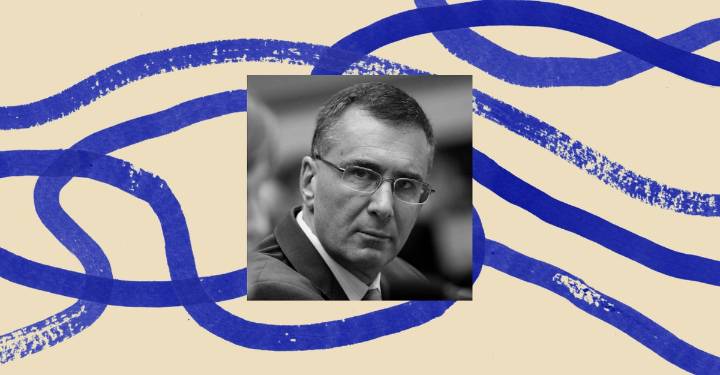
On this week’s episode of The David Frum Show, The Atlantic’s David Frum opens with his thoughts on the shocking alleged corruption that has informed President Donald Trump’s actions toward Ukraine and the scandal of the recently proposed “peace plan” by the United States. He goes on to discuss how the many scandals of the Trump presidency make it hard to focus on just one, as it is quickly replaced in the news cycle by another.
Then David is joined by Jonathan Gruber, an economics professor and the chairman of the economics department at MIT. Gruber discusses the backlash he faced as a key architect of the Affordable Care Act and why the American health-care system still feels so broken. David and Gruber also talk about the war on both vaccines and science that is being waged by the conservative right.
Finally, David closes the episode with a discussion on They Thought They Were Free, by Milton Mayer, and what we can learn about teaching soldiers to commit crimes.
The following is a transcript of the episode:
David Frum: Hello and welcome to The David Frum Show. I’m David Frum, a staff writer at The Atlantic. My guest today will be Jonathan Gruber, professor of health-care policy at the Massachusetts Institute of Technology and one of the principal architects of the Affordable Care Act (Obamacare). In the final segment of the show, I will discuss the book They Thought They Were Free, by Milton Mayer, a 1955 study of a small German community where people had to come to terms with the terrible things that were done by them, by their neighbors, and by their government during the Third Reich. It’s a book full of historical interest, but also with implications for any society trying to come to terms with its past to build a better and more honorable future.
Before the dialogue and before the book discussion of the week, some preliminary thoughts. In November, the United States adopted as its own a diplomatic document that imposed Russian terms on the independent country of Ukraine. The document imposed terms of territorial surrender, compromise of Ukrainian sovereignty, limits on the Ukrainian armed forces—all of them Russian wish lists—in return for nothing more from Russia than a temporary cessation of violence against Ukraine. It was a shocking surrender document. And the question that bothered a lot of people is, as bad as the Trump administration has been on Ukraine, as far as they’ve gone toward the Russian point of view, nothing like this; this is beyond anything ever seen before. How could it have happened?
Well, on November 28, The Wall Street Journal produced a report that explained how it could have happened. It turns out that, at the same time as the Trump team was negotiating with the Russians over Ukrainian surrender, connected insiders were working with their Russian counterparts on a series of business deals, to enrich themselves after the end of conflict with deals on energy, rare earth, on highly favorable terms to the Americans. The Russians, it looks very much like, were simply paying Trump insiders to gain clout to put pressure on Ukraine to surrender to Russian terms.
Now, this story, highly detailed, would’ve been one of the most shocking stories of the Trump administration so far if it hadn’t been juxtaposed by another terrible story that very same day, where President [Donald] Trump announced his intention to pardon the former president of Honduras, Juan Orlando Hernández, convicted as one of the biggest cocaine dealers in American history—sending tons of cocaine into the United States, arranging for bribes and murders—convicted and sentenced to 45 years in an American prison. And Trump announced his intention to pardon this tremendously sinister drug figure at the same time as he is sending little boats to the bottom of the Caribbean with their small-scale drug dealers still aboard, some of them apparently, or reportedly, killed in cold blood. How does this make sense?
Well, Hernandez is, of course, wired and connected to all kinds of people. He had influential friends. And it’s just one of a pattern of strange commutations and pardons from the Trump administration. Here’s another: President Trump commuted the sentence of David Gentile, a private-equity guy convicted of defrauding hundreds of investors of more than $1 billion.
The cavalcade, the onslaught of corruption stories just never stops. It seems like there’s one a week. And some of them are so familiar that we’ve stopped even mentioning them, like in October, the Republican majority of the Senate voted down a Democratic proposal not to finance the Qatari jet—remember that—that the Pentagon accepted on Trump’s behalf and that the taxpayer is now spending hundreds of millions of dollars to outfit for Trump and that, according to the terms of the gift, are to be taken with Donald Trump to his so-called presidential library, but for his use after he ceases to be president. That is no longer a big story, but it still continues.
We continue to remark on the novelty news of the glitzy, crazy White House ballroom, now enlarged to hold 1,350 people, and there are all kinds of problems with the asbestos and the wiring and the windows. And it’s financed by hundreds of millions of dollars in gifts from corporations with interests before the Trump administration. It’s just one thing after another like this.
The first Trump administration was beset by many, many scandals, but there was still, despite the scandals—or along with the scandals—an administration there. There was some sense of policy, some things they wanted to do. This administration seems like a series of scandals masquerading as an administration. Even the seeming policies, like the tariff policy, turn out to be mechanisms and vehicles for scandal politics. The value of a tariff is not that it’s going to do anything for American industry; industrial employment and manufacturing employment is trending down under Donald Trump. But it is a thing that you can do to an industry, you can afflict upon an industry, that some industries will pay you to have relief from. And it’s precisely this ability to buy and sell relief from tariffs that makes the tariff policy so extraordinarily interesting to the Trump administration.
When this all ends—and I am confident it will end and that the end is coming and maybe pretty soon—we’re going to need more than to treat this episode as a chapter in American history. The “Bygones will be bygones” approach taken by the Biden administration seems not adequate to the needs of the moment, seems not adequate to what has happened and been done in this first year of Trump. There’s going to need to be a serious investigation to get to the bottom of things. There’s going to need to be serious publicity. There’s going to need to be accountability and consequences to the limits of the law. And where the law does not provide for consequences, where Trump and the people around him have invented some new way of being corrupt that no one ever wrote a law to prohibit because no one ever imagined a president would do such a terrible thing, well, then we’re going to need some new laws, some serious reforms, things that were generally not done during the [Joe] Biden years, but that need to be done now.
It’s not just a chapter of history; it’s a warning to the future, and it’s a challenge to Americans to do better, to make sure that such things never happen again. And while we can’t restore the lives of those who were wrongfully killed by the Trump administration in the Caribbean Sea, we can ensure that the kind of disregard for law that enabled those killings, that that at least comes to an end. That’s at least the hope. That’s at least the conviction. Maybe that’s a promise we need to make to ourselves.
And now my dialogue with Jonathan Gruber.
[Music]
Frum: Unless you follow health debates closely, you may not immediately recollect the name of my guest today. But a dozen years ago, Jonathan Gruber stood nearly at the top of the roster of demon figures on the American far right. If you watched Glenn Beck’s program on Fox News or listened to Rush Limbaugh on the radio, Jonathan Gruber ranked with [Adolf] Hitler and [Joseph] Stalin among history’s greatest monsters. I don’t mean that as a figure of speech, either—on a November 2013 program, Limbaugh literally accused Gruber of believing in eugenics of the kind that directly led to the Holocaust. Gruber’s offense was his leading role in the design of the Affordable Care Act, nicknamed Obamacare. A professor at the Massachusetts Institute of Technology, Gruber is a career scholar of the American health-care system.

 Health Digest
 Crooks and Liars
 The Babylon Bee
 NBC News
 Reuters US Top
 KY3
KY3 CBS Colorado Politics
 CNN Politics
 Raw Story