

 Reuters US Economy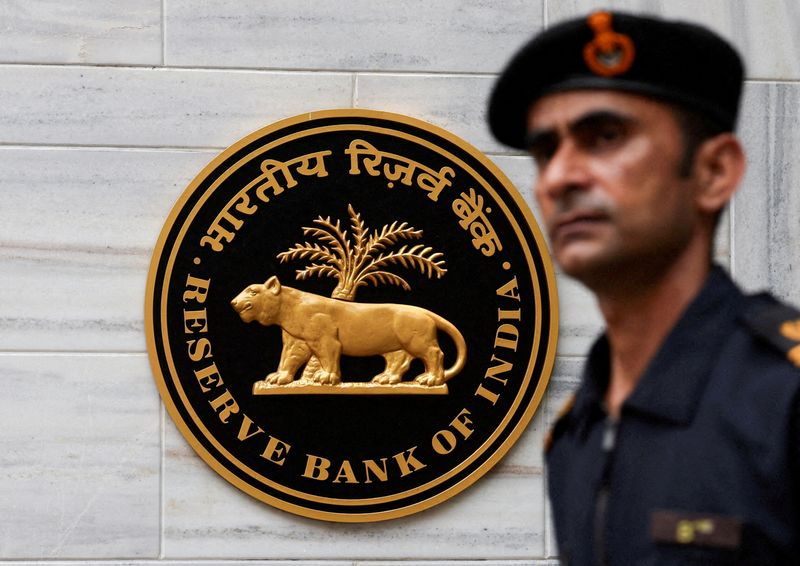
By Jaspreet Kalra, Swati Bhat and Nimesh Vora
MUMBAI, Dec 4 (Reuters) - India's central bank will tolerate a weaker rupee as the country's external sector confronts multiple headwinds including a wider trade gap and stalling of dollar inflows into the world's fifth-largest economy, three sources familiar with the central bank's thinking told Reuters.
The Reserve Bank of India (RBI), which had supported the rupee through aggressive interventions via dollar sales until last month, has allowed the rupee to fall 1.3% in the last seven trading sessions to a record low of 90.42 per dollar.
The rupee, down 5.5% on year, is Asia's worst performing currency.
By signaling tolerance for a weaker rupee, the central bank is indicating that it will intervene mostly to curb sharp volatility or on any signs of a speculative build-up but not defend any specific level on the rupee, the sources said.
"It doesn't make sense to spend reserves when fundamentally everything is against the currency," said one of the sources, who commented on condition of anonymity as they were not authorised to speak to the media.
The RBI did not immediately respond to an email seeking comment.
"As and when fundamentals and real dollar demand dictate, the central bank does let the rupee move more than it normally would," the second source said.
India is one of the worst-hit markets in terms of outflows, with foreign investors selling stocks amounting to $17 billion so far this year. At the same time, foreign direct investment, trade, and offshore fundraising flows have slowed down.
While the currency's fall below the psychologically important 90 per dollar mark has garnered attention and could embolden speculators, the central bank can step in to stamp those out as needed, a third source said.
INVESTORS ON GUARD
A weaker currency provides more policy flexibility to the central bank, but it could also diminish the appeal of Indian assets for overseas investors.
"A weakening Indian rupee is definitely a negative when it comes to investing in Indian equities and it is one reason why we are only neutral weight in India versus our benchmark," said Sam Kongrad, an investment manager for Asian equities at Jupiter Asset Management.
MSCI's India equities index has risen 7% this year, but currency weakness has trimmed its dollar returns to under 2% — well below the roughly 80% and 30% gains posted by South Korea and Hong Kong, respectively.
"A resolution to the tariff situation with the U.S. can’t come soon enough and foreign flows from a potential global index inclusion will be very much needed," said Kenneth Akintewe, head of Asian sovereign debt at Aberdeen Investments.
Over the long term, though, investors reckon sustained momentum in India's blockbuster economic growth could help offset the currency's fall by boosting company earnings.
India's GDP grew 8.2% in the July-September quarter even as the rupee languished at a record low, underscoring a divergence between the strong domestic economy and weak external demand.
"I'm not losing sleep over it," India's Chief Economic Advisor V Anantha Nageswaran said on Wednesday, referring to the rupee's fall. The rupee's weakness has had no impact on inflation, he added, expecting the currency to recover in 2026.
(Reporting by Jaspreet Kalra, Swati Bhat and Nimesh Vora; additonal reporitng by Ankur Banerjee; Editing by Shri Navaratnam)

 Newsweek Top
 The Daily Beast
 AlterNet
 America News
 Associated Press US News
 CBS News
 ABC 7 Chicago Sports
 RadarOnline
 NHL
NHL Raw Story