

 Reuters US Domestic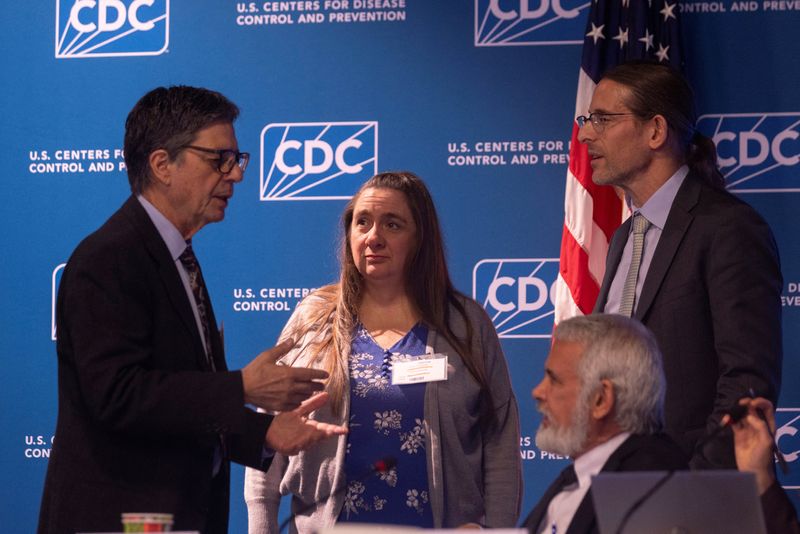
LOS ANGELES, Dec 7 (Reuters) - U.S. vaccine advisers' decision to scrap longstanding guidance on hepatitis B shots will expose more children to the harmful virus and may signal how other evidence-based vaccine policies can be undermined, doctors and disease experts said.
Since 1991, U.S. health officials have recommended universal vaccination for infants against hepatitis B, with the first of three shots administered very soon after birth. The move has cut infections dramatically and saved lives, federal data show.
On Friday, an advisory panel appointed by Health Secretary Robert F. Kennedy Jr said a birth dose should only be given to newborns whose mother tests positive for hepatitis B or whose status is unknown. In cases where the mother tests negative, parents should decide with their doctors when, or even if, their children should receive any hepatitis B vaccines, the panel said.
The advisers, many of whom share Kennedy's anti-vaccine views, provided no evidence of new harms from the shot. They argued that vaccination was too broad compared to the risk of infection and that U.S. policy was out of step with certain developed countries.
"Do you want to expose your child, your baby, to an intervention that could have some potential harms when the risk is so low?" said Retsef Levi, one of the advisers who supported the new recommendation.
EXPERTS WARN OF RISKS
Disease experts said that current U.S. infection rates are low thanks to the decades-old vaccination policy and warned that will change if the Trump administration accepts the new recommendation. More families will likely opt out of vaccination without a firm federal policy in place, and children can be easily infected through exposure to household members other than their mothers, who may not be aware they have hepatitis B.
Many people with hepatitis B do not have symptoms and are unaware of their infection. In infants and young children, an initial infection becomes chronic in about 95% of cases, potentially causing liver damage and liver cancer decades later, according to the World Health Organization.
"This is a watershed moment for our country," said Dr. Alex Cvijanovich, a pediatrician in Albuquerque, New Mexico. "I don't think it's going to take long to start seeing cases of hepatitis B come back, and I think that the burden of these cases will lay squarely on the shoulders of a group of people who don't understand the science of vaccines."
TRUMP BACKS FULL REVIEW OF CHILDHOOD VACCINATION POLICY
The repudiation of a safe and successful vaccine also raises concerns over how the advisory panel will conduct a planned review of all routine childhood immunizations, according to former vaccine advisers, pediatricians and experts in infectious diseases.
Late on Friday, President Donald Trump stressed his support for such a review, instructing Kennedy to study how U.S. childhood vaccine policy differs from "peer, developed countries," and make changes where warranted.
“What they are really doing is dismantling the vaccine schedule," said Dr. Flor Munoz, an infectious diseases specialist at Texas Children's Hospital. "Every other vaccine is probably going to fall under their plan."
HHS spokesman Andrew Nixon said in a statement to Reuters "there is no way to infer broader change" from the decision on hepatitis B shots or assume that it “sets a template for rolling back other childhood vaccine recommendations.”
The decision by the Advisory Committee on Immunization Practices (ACIP) must be adopted by the Centers for Disease Control and Prevention's acting director before taking effect. It will help determine states' immunization requirements, insurance coverage and procurement for the CDC's Vaccines for Children program relied upon by many families.
Robert Malone, vice chair of the ACIP panel, supported the new recommendation. Public health "is focused on maximizing the greatest good for the greatest number," he said. "The counterbalance to that is the need to respect the rights of the individual for self-determination."
U.S. hepatitis B infections have fallen nearly 90% from about 9.6 per 100,000 before vaccination became widespread to approximately one per 100,000 in 2018, according to the CDC.
Major side effects, such as allergic reactions, are very rare. Before routine vaccination at birth, 18,000 U.S. children contracted the virus each year by age 10, according to the American Academy of Family Physicians.
“Some of these committee members would indeed be pleased if some parents chose never to vaccinate their children against hepatitis B," said Dr. William Schaffner, an infectious diseases specialist at Vanderbilt University and a former ACIP member. "They've turned back the clock to pre-1991."
MEDICAL SOCIETIES TO IGNORE NEW VACCINE GUIDANCE
Leading U.S. medical societies, including the American Academy of Pediatrics, and at least 12 states said they would ignore the new recommendation and continue to support the hepatitis B vaccine for all newborns. They include Arizona, California, Colorado, Hawaii, Illinois, Massachusetts, Maryland, Michigan, New Jersey, New York, North Carolina and Rhode Island.
The full impact from a reversal will take time to materialize, making it harder to communicate the risks to families, according to pediatricians and disease experts.
Dr. Sharon Nachman, chief of pediatric infectious diseases at Stony Brook Children’s Hospital in New York, said the concern within the medical community is that more families will buy into the notion promoted by Kennedy, but unsupported by scientific evidence, that vaccines cause more harm than the diseases they prevent. It will take much longer for the worst complications of hepatitis B to show up.
"This is a 20-year ticking time bomb," she said.
(Reporting by Chad Terhune in Los Angeles, Nancy Lapid in Tucson and Julie Steenhuysen in Chicago; Editing by Michele Gershberg and Diane Craft)

 The Conversation
 Verywell Health
 WBAL-TV 11 Baltimore Covid-19
 Local News in Florida
 Daily Kos
 CBS News
 Rolling Stone