

 The Atlantic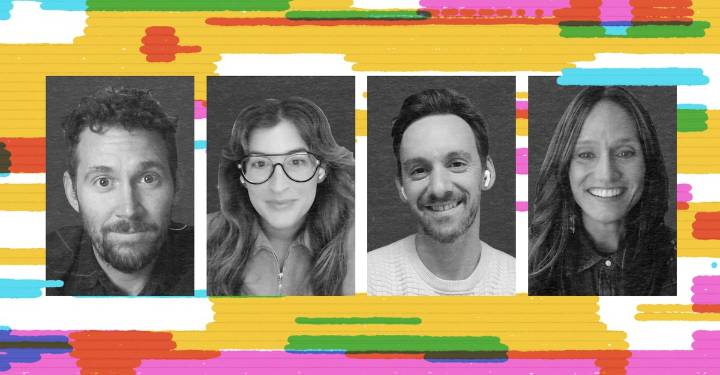
Subscribe here: Apple Podcasts | Spotify | YouTube
In this episode of Galaxy Brain, Charlie Warzel turns the camera on himself to ask a simple question: Why are you seeing his face?
Using YouTube’s takeover of podcasts as a starting point, he explores how video has devoured audio and turned podcasts into something closer to daytime TV and late-night talk shows. NPR’s Rachel Martin, host of the celebrity-interview show Wild Card, joins to talk about her own shift from intimate, audio-only conversations to highly visible video chats with mega-celebrities. She explains how the visual layer changes everything—from building trust with guests and audiences to deepening parasocial relationships, and why showing your face is necessary in a low-trust media world.
To trace the business and cultural arc of this pivot, Bloomberg reporter Ashley Carman explains the rise and fall of the podcast “gold rush”—from the Serial era to Spotify’s billion-dollar bet, to the collapse of expensive narrative audio and YouTube’s emergence as a true power player. Then, writer and Plain English host Derek Thompson joins to explain his theory that “everything is television now.” Warzel and Thompson explore how short-form video, autoplay feeds, and video podcasts are reshaping our attention, our politics, and even our sense of self—turning podcasts into background “wallpaper” while nudging more of us into broadcasting our lives. Together, the conversations sketch a weird, slightly berserk future where video podcasts aren’t just a format—they’re a window into a lonelier, more fragmented, video-first culture.
The following is a transcript of the episode:
Derek Thompson: Do you actually need to sit still by yourself and listen to your thoughts, ever? Like, is that good for you at all? Should you just always choose to, like, download other people’s thoughts inside of your brain so you’re never stuck with the sort of, you know, subvocal questions of your own consciousness?
I feel honest about this, because I’m not sure that these are, like, familiar feelings. I feel like we’re sort of being thrust into, again, a kind of really unnatural experiment based on these technologies. And, you know, given the changes in mental health over the last few decades, it’s not entirely clear to me that surrounding ourselves with the constant … bombarding ourselves with the constant thoughts for the people is particularly good for our sanity.
[Music]
Charlie Warzel: Hello, and welcome to Galaxy Brain. I’m Charlie Warzel. And if you’re watching this on YouTube, welcome to my face—and apologies for my face, which is actually the subject of today’s show. Why are you seeing my face, or, perhaps more appropriately, why did YouTube devour podcasting? So as a technology reporter, one thing that I absolutely love is just being an internet crash-test dummy, right there.
I think that there’s no better way to understand a platform than to try to make things and share things on them. So part of my reporting has always been to try to lean into riding the algorithmic waves myself and just watching what happens, right? That’s a big reason why we launched Galaxy Brain as a video podcast.
There’s all these questions that I have. Like, you know, how do YouTube thumbnails and titles change the way that a video performs? What happens when you make something evergreen versus something newsy? How valuable is a celebrity to having your video go viral? Ultimately, who’s watching these things, right?
I feel like there’s just no better way to really understand what is happening online than to do things online. And so that’s just one very small reason why you’re seeing my face, right? But it’s not just me. There’s just a lot of people in media and journalism who were previously scribes or just audio podcasters, right, who’ve become YouTubers or TikTokers.
And so you could say that this is just like pivoting to video, right? Back in the 2010s, there was this sort of infamous “pivot to video,” mostly caused by people responding to incentives on Facebook. And it was mostly disastrous for people. As a digital-media survivor of the 2010s, I had to endure that.
And I think that what’s happening now, though, is different. I think it’s much less responsive to the whims of these platforms, and I think it’s a lot more driven by audiences. It’s also a lot more popular. In late 2024, this research firm, Edison Research, said that “YouTube has risen to the top as the most popular service used for podcast listening in the United States. Thirty-one percent of weekly podcast listeners 13 and up choose YouTube as the service that they use to listen to it.” That’s well surpassed Spotify, which is at 27 percent, and Apple Podcasts, which is at 15 percent. They also said that “84 percent of Gen Z monthly podcast listeners listen or watch podcasts with a video component.” And so it’s very popular to be a YouTuber with a podcast.
This trend has been moving pretty steadily since about 2019, and that’s when some popular podcasts started posting to YouTube and seeing some success with these short clippings. They were called YouTube Shorts. And this was getting a lot of traction in YouTube’s algorithm, but it’s booming now.
This past October, Spotify announced that a bunch of their popular podcasts from The Ringer, like the Bill Simmons show—they’re all going to be streaming on Netflix. And so, essentially, what you have is podcasts that are behaving like normal television. There’s been a whole bunch of weird sort of externalities that have come out of this.
Recently, Bloomberg reported on this outgrowth of this video-podcasting boom, and one thing that’s happened is the rise of clippers. So these are people that capture the best moments from various videos online, and they seed them across social media. Really big YouTubers like Mr. Beast have hired them to do work for them, and they pay about $50 for every hundred thousand views.
You’ve also got record labels that are employing clippers to take miscellaneous video footage and pair it with artists’ songs on places like TikTok. In this weird way, this is this convergence of all media into one big blob of short-form video content, right? I think that all of this is just changing consumption behaviors.
I hear this from a bunch of people in my life, who—they come home, and they turn on YouTube, and they stream podcasts while they do other things. They do it from their TV. And so it seems like podcasts have moved from, like, not even a second-screen experience, right? It’s like a one-and-a-half-screen experience.
And so I think that there’s something here. I think that the shift tells us quite a bit about the way that people are moving away from the medium of text and toward basically anything that’s similar to short-form video content. Anything that can be clipped, edited, picked apart, put on social media to go viral.
And I think that all this has a lot to do with our attention spans, but also the parasocial relationships that people are developing with people who used to be in their ears a whole bunch of hours a week. Right? People are interested in seeing these creators inside and out, including their workspaces. And, apologies again. I think that this change has something to tell us about our culture and our technology, and I think it can maybe even help explain other anecdotal trends—like these concerns that people aren’t reading as much as they used to. This is a big, sprawling, really interesting topic. And to tackle it, I’ve assembled what I think is a murderer’s row of guests: people who work as video podcasters, analysts in the podcast space, and media thinkers that I’ve admired for quite a while.
So today, we’re going to figure out why you’re seeing my face. My first guest is NPR’s Rachel Martin: the host of the popular celebrity-interview show called Wild Card. And by now, a video-podcast pro.
Rachel, welcome to Galaxy Brain. Thank you for being a guinea pig in this experiment of ours.

 The Journal Gazette
 The Baltimore Sun
 Arizona's Family
 Associated Press Top News
 SI NBA
 Vogue Fashion
 The Daily Beast
 New York Magazine Intelligencer
 The Hill
 NPR
NPR