

 The Atlantic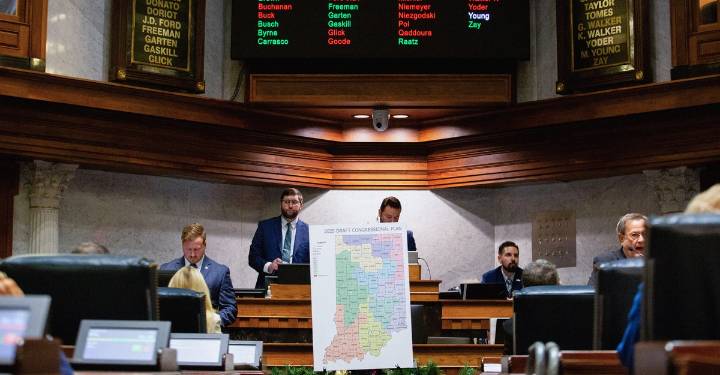
In rejecting yesterday a redistricting plan backed by President Donald Trump, Indiana’s Republican-controlled senate did not merely deny Republicans two new U.S. House seats in next year’s midterm elections. They also engaged in a mass revolt against the president. The stakes of their defiance reach far beyond the midterms. This vote was possibly the most significant blow yet against the authoritarian ambitions that have defined Trump’s second term.
The significance of Indiana’s noncompliance lies not in the specifics of what was refused—attempts to gerrymander electoral maps are hardly unprecedented, even though a mid-decade battle violates norms—but in the act of refusal itself. Trump’s authoritarian project relies on the cultlike hold he has over his party. Republicans have come to understand that the cost of defying Trump is the death of their political career. Trump has proved time and again that he will go to any lengths to destroy his intra-party critics, even if doing so harms the party.
That method was on vivid display in Indiana. Trump expected the state to go along with his plans to redraw its map to help his party in the midterms. When the state’s Republicans held back their support, Trump and his allies went on the attack.
[Russell Berman: The state that handed Trump his biggest defeat yet]
Indiana Republican legislators faced bomb threats and intimidation in their homes (such as “swatting,” phone calls, and the like)—a climate of fear, my colleague Russell Berman reports, unlike anything the state has seen.
Heritage Action delivered a Mafia-like threat, as high-minded scholars apparently do these days: “President Trump has made it clear to Indiana leaders: if the Indiana Senate fails to pass the map, all federal funding will be stripped from the state. Roads will not be paved. Guard bases will close. Major projects will stop. These are the stakes and every NO vote will be to blame.”
This kind of pressure typically bends targets to Trump’s will. What politician is willing to sacrifice their career or their family’s safety for a single act of defiance?
Yet the spines of Indiana Republicans stiffened where so many others snapped. One reason for this may be that the state contains an unusually strong concentration of Trump-skeptical former governors. Mitch Daniels and Mike Pence remain influential in the state, despite having given up national ambitions by failing to submit fully to Trump. Daniels praised the vote as an act of “principled courageous leadership.”
Indiana’s Republicans also demonstrated strength in numbers. Trump employs the psychology of a schoolyard bully who isolates and targets victims one by one. By engineering a 31–19 vote, Indiana’s Republicans worked together to ensure that no single legislator could be blamed for defying Trump.
Trump’s power has long relied on his political immortality—his seemingly mystical bond with the party faithful and his phoenix-like return to the White House. Indiana’s Republicans seem emboldened by evidence of the president’s political decline. Trump has done almost nothing to maintain the coalition that elected him last year, and almost all of his major moves have cost him support: a wildly aggressive immigration agenda, inflationary tariffs, flamboyant corruption, and a toxic mega-bill that paired benefits for the rich with cuts to the poor.
[Marc Novicoff: Welcome to the gerrymandering apocalypse]
Political reality is settling in. Last month’s off-year election drove home that the electoral coalition that showed up in November 2024 is gone. Republicans seem resigned to losing the U.S. House next year, which dulls the appeal of violating norms to protect a doomed majority.
Trump’s control over the future of the party is also now in doubt. Ted Cruz and Marjorie Taylor Greene have expressed interest in running for president, which signals their belief that the party’s voters may soon back a candidate who defies Trump.
Two opposing forces have dominated the first year of Trump’s second presidency. The first is a domestic agenda that has generated an intense backlash. The second is a series of steps designed to blunt the impact of that backlash. Most of Trump’s authoritarian moves—prosecuting his enemies, giving his allies legal carte blanche, pressuring media owners to give him friendlier coverage—are meant to create a kind of wall to hold back the waves of public anger brought forth by his policies. His efforts to voter-proof the House map are a key part of that defense.
The wall and the backlash have risen in tandem, the latter faster than the former. And now, for the first time, it seems the wall itself is beginning to crumble.

 Breitbart News
 Louisville Public Media
 IndyStar
 CNN Video
 Raw Story
 AlterNet
 The Daily Beast