

 USA TODAY National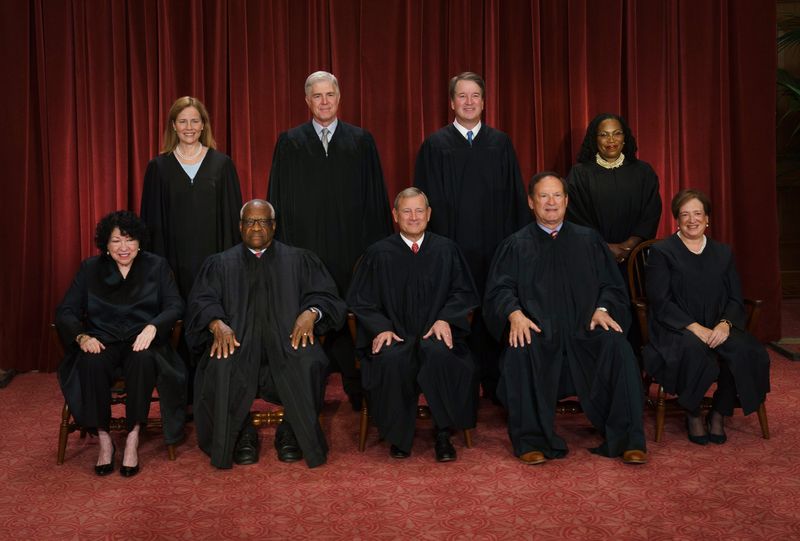
The Supreme Court heard oral arguments Dec. 8 in Trump v. Slaughter, a rather innocuous case that has the potential to reshape the landscape of our government’s separation of powers.
While this case is important, so too is the manner in which the news media frames its coverage of these cases. The way journalists discuss cases of executive power, and in turn how many members of the public interpret them, is fundamentally wrong.
The Supreme Court’s conservative majority is ideological, not partisan. Pretending otherwise is shortsighted and will lead to a poor understanding of why the court behaves as it does.
Will the Supreme Court give Trump more power? It's not that simple.
In Trump v. Slaughter, the court answers whether President Donald Trump can fire Rebecca Slaughter, a member of the Federal Trade Commission. The commission is an independent agency created by Congress. It has five commissioners, no more than three of whom can be from the same political party, who serve seven-year terms.
By law, the president can only remove commissioners for “inefficiency, neglect of duty, or malfeasance in office.”
Trump fired Slaughter in March, saying that her service "is inconsistent with my Administration’s priorities." Slaughter challenged her firing, and now the issue is before the court.
Commonly referred to as just “Humphrey’s Executor,” that precedent is from a 1935 Supreme Court case concerning the exact statute. That ruling upheld the statute limiting the president’s removal authority. Conservative judges have questioned the viability of independent agencies.
Media framing of the Supreme Court is all wrong
Much of the news coverage surrounding this decision, as well as many others, I think, is completely disingenuous. The common framing I see is that the Supreme Court is “poised to expand Trump’s power over independent agencies.”
The court won't decide anything for Trump. The justices will decide in the conservative interest of the separation of powers, regardless of who the president is.
Sure, I understand that people who have a less favorable view of originalist jurisprudence than I are naturally going to be more skeptical of the conservative majority's motives.
This is not a new legal fight. Others have detailed, for example, the debates between conservative Chief Justice John Roberts and liberal Justice Elena Kagan that have gone on for years. None of this amounts to corrupt jurisprudence in the interest of Trumpism.
It's also not true that the Supreme Court is solely interested in expanding executive power for its own sake. Just last year, the Supreme Court overruled Chevron v. Natural Resources Defense Council of 1984, a somewhat technical case that bound courts to defer to an executive agency's interpretation of an ambiguous statute. If that sounds really malleable, it was, and that is precisely why it was overruled.
Some will counter that a Democratic president wouldn't bring such cases for the Supreme Court to support their pet project. To an extent, this is true, but Joe Biden took various actions to expand executive power, particularly through his student loan forgiveness scheme.
The difference between the sorts of cases that arise under Democratic presidents and the Slaughter case is that here the court would be expanding the president's authority within his own branch of government. Other cases, such as the Trump tariff case, are unlikely to turn out in the president's favor because they mark an expansion of executive power over the functions of the other branches, in that case, the legislative.
Conservative Supreme Court justices are ideological, not partisan
The Supreme Court’s undertaking is oriented toward originalism. This often overlaps with Republican partisan outcomes, but as illustrated above, it doesn’t always.
Consider our government’s separation of powers into three branches: the executive, the legislative and the judicial. In recent decades, the lines between those boxes have become blurred; executive agencies are legislating, judges have tried their hand at legislating, and Congress has done absolutely nothing to reassert its power.
The conservative majority of the Supreme Court is on a mission to put everything back into the right box and cut away everything that exists outside of those boxes, such as independent agencies. The goal is not to grow or shrink the power of any individual branch for that purpose alone, but rather to reorient each of the branches into its constitutionally appropriate role.
Their first major step in this undertaking came in the form of overturning the 1984 "Chevron deference." The second, though precisely how is unclear, is likely to come when the nation's highest court resolve Slaughter’s firing at the FTC. There will be many more to come.
Opponents of this undertaking may criticize it or the conservative majority's decisions in pursuit of that goal, but characterizing it as a partisan goal is a misunderstanding of the situation. It will lead to a shallow view of the Supreme Court.
Dace Potas is an opinion columnist for USA TODAY and a graduate of DePaul University with a degree in political science.
This article originally appeared on USA TODAY: This is why you're wrong about the Supreme Court and Trump | Opinion
Reporting by Dace Potas, USA TODAY / USA TODAY
USA TODAY Network via Reuters Connect

 AlterNet
 CNN Video
 Raw Story
 Reuters US Domestic
 The Federick News-Post
 Associated Press US and World News Video