

 Associated Press US News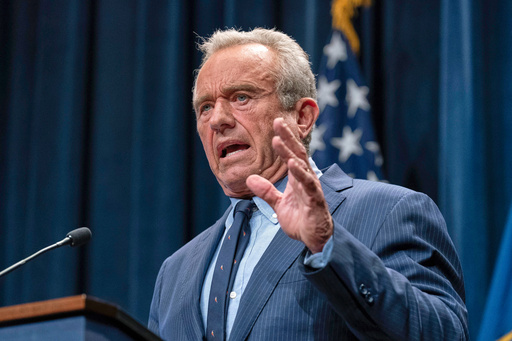
A federal vaccine advisory committee convened Thursday in Atlanta to discuss whether newborns should still get the hepatitis B vaccine on the day they're born.
For decades, the government has advised that all babies be vaccinated against the liver infection right after birth. The shots are widely considered to be a public health success for preventing thousands of illnesses.
But U.S. Health Secretary Robert F. Kennedy Jr.’s committee is considering whether to recommend the birth dose only for babies whose mothers test positive, which would mark a return to a public health strategy that was abandoned more than three decades ago. For other babies, it will be up to the parents and their doctors to decide if a birth dose is appropriate.
Committee member Vicky Pebsworth said a work group was tasked in September with evaluating whether a birth dose is necessary when mothers tested negative for hepatitis B.
“We need to address stakeholder and parent dissatisfaction" with the current recommendation, she said.
The committee makes recommendations to the director of the Centers for Disease Control and Prevention on how already approved vaccines should be used. CDC directors almost always adopted the committee’s recommendations, which were widely heeded by doctors and guide vaccination programs. But the agency currently has no director, leaving acting director Jim O'Neill to decide.
Kennedy, a leading anti-vaccine activist before he became the nation’s top health official, fired the entire 17-member panel earlier this year and replaced it with a group that includes several anti-vaccine voices.
The panel has made several decisions that angered major medical groups.
At a June meeting, it recommended that a preservative called thimerosal be removed from doses of flu vaccine even though some members acknowledged there was no proof it was causing harm.
In September, it recommended new restrictions on a combination shot that protects against chickenpox, measles, mumps and rubella. The panel also took the unprecedented step of not recommending COVID-19 vaccinations, even for high-risk populations such as seniors, and instead making it a matter of personal choice.
Several doctors groups said the changes were not based on good evidence, and advised doctors and patients to follow guidance that was previously in place.
Hepatitis B is a serious liver infection that, for most people, lasts less than six months. But for some, especially infants and children, it can become a long-lasting problem that can lead to liver failure, liver cancer and scarring called cirrhosis.
In adults, the virus is spread through sex or through sharing needles during injection drug use.
But it can also be passed from an infected mother to a baby. As many as 90% of infants who contract hepatitis B go on to have chronic infections, meaning their immune systems don’t completely clear the virus.
In 1991, the committee recommended an initial dose of hepatitis B vaccine at birth. Over about 30 years, cases among children fell from about 18,000 per year to about 2,200.
But members of Kennedy's committee have voiced discomfort with vaccinating all newborns.
Cynthia Nevison, an autism and environmental researcher, presented at the meeting. Nevison has written opinion pieces published by Children’s Health Defense, an anti-vaccine advocacy organization Kennedy previously led. She also co-authored a 2021 article in the Journal of Autism and Developmental Disorders that the publication retracted after concerns were raised about the paper’s methodology and about nondisclosed ties between the authors and anti-vaccine groups.
Another presenter was Mark Blaxill, a co-author of the retracted paper, who spoke about vaccine safety.
In the past, committee meetings have relied on presentations by the CDC scientists involved in tracking vaccine-preventable diseases and assessing vaccine safety. The agenda for this meeting listed no CDC scientists, but rather featured a prolonged public airing of anti-vaccine theories that most scientists have deemed as discredited.
Kennedy is a lawyer by training. Aaron Siri, a lawyer who worked with Kennedy to sue vaccine makers, is listed as a presenter on Friday on the topic of the immunization schedule for U.S. children.
The current guidance advises a dose within 24 hours of birth for all medically stable infants who weigh at least 4.4 pounds (2 kilograms), plus follow-up shots to be given at about 1 month and 6 months. The committee is expected to vote on language that says when a family decides not to get a birth dose, then the vaccination series should begin when the child is 2 months old.
___
The Associated Press Health and Science Department receives support from the Howard Hughes Medical Institute’s Department of Science Education and the Robert Wood Johnson Foundation. The AP is solely responsible for all content.

 TODAY Video
 PBS NewsHour Politics
 KETV NewsWatch 7
 America News
 Raw Story
 CBS Colorado Politics
 NBC10 Philadelphia
 The Babylon Bee
 The Atlantic
 ABC 7 Chicago Health
 AlterNet