

 USA TODAY National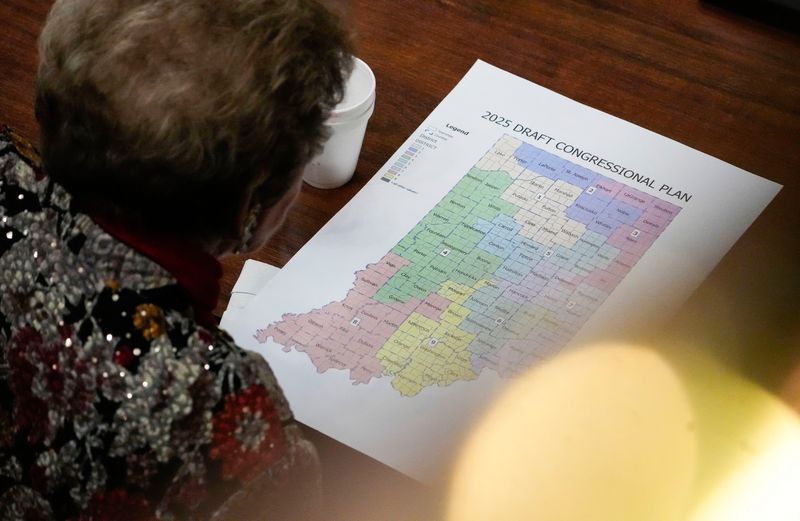
A mid-decade redistricting bill has cleared its first chamber in the Indiana legislature, passing the state House Dec. 5 by a 57-41 vote.
It's a significant milestone for the new congressional map proposal, drawn in direct response to a request from President Donald Trump after months of pressure, both direct and indirect. A dozen Republicans joined with Democrats in voting against the proposal.
The map proposal now goes to the Indiana Senate, where its fate is far less certain.
The Senate is split on the concept of redistricting mid-decade with the explicit goal of creating more Republican-favored districts ahead of the 2026 midterm elections. Senate President Pro Tempore Rodric Bray has twice rebuffed the idea of convening to do so before ultimately agreeing to meet next week.
Indiana had held off on redistricting for months and weathered intense pressure, in the form of visits from Vice President JD Vance, voter outreach campaigns from little-known nonprofits, threats of primary pressure from Trump himself, and lately, threats of violence against Indiana lawmakers.
The redistricting bill's passage in the House was almost certain, despite House Democrats' attempts to thwart the proceedings by denying quorum and challenging the convening on technical grounds.
Several Democrats on Dec. 5 injected personal exasperation into their remarks, noting the lack of enthusiasm and smiles on the other side of the room. Rep. Matt Pierce, D-Bloomington, appeared to choke up slightly as he reflected on his longstanding friendships across the aisle and how times feel different now.
"I’ve never once got the sense from the other side of the aisle that basically you really shouldn’t even exist," he said. "Why do we have to do it? We know it doesn’t really make sense."
Among Republicans, only the bill's author, Rep. Ben Smaltz, and House Speaker Todd Huston spoke about the bill. In response to questioning from Democrats, Smaltz reiterated an oft-repeated concept, that this was done purely for political performance in elections.
Just before the final vote, Smaltz defended the process as adhering to laws and the Constitution, noting that nothing prevents state legislatures from redrawing maps "when circumstances demand it," and not just during census time. He also argued the process has been transparent, despite Democrats' vehement arguments to the contrary.
Draft maps were publicly released, and public testimony was held, though all in the span of less than a week.
"No redistricting process is going to satisfy everybody," Smaltz said. "We do not choose the timing, the circumstances choose it for us. Responsible leadership requires action."
Twelve Republicans voted against the redistricting bill, including multiple members of elected House leadership.
What the bill does
The bill describes a new and significantly altered congressional map that, at the most basic level, breaks up the state's most heavily urban areas and combines them with rural swaths to create nine Republican-advantaged seats and zero Democratic-advantaged seats.
Under Indiana's current map, Democrats hold two seats, in Marion County and Northwest Indiana.
But under the proposal, Marion County is carved into four new districts, sparking concerns about diluting the voting power of non-White residents.
The bill drastically improves Republicans' electoral odds. Democrats now have a 78% and 99% chance of winning the 1st and 7th Congressional Districts, respectively, according to PlanScore; under this proposal, their winning odds would plummet to 9% and less than 1%.
Beyond drawing a new map, House Bill 1032 also takes the unusual step of prohibiting courts from temporarily blocking the map should lawsuits surface, as anticipated. It does not block courts from issuing a permanent injunction.
The Indiana redistricting battle
The bill attracted more than five hours of committee discussion and public testimony on Dec. 2, overwhelmingly representing opponents of redistricting.
It ultimately passed the House elections committee easily. Just one Republican ― Rep. Tim Yocum of Clinton ― voting no with Democrats. He declined to explain his vote, saying simply, "My vote is my answer."
Democrats tried 15 times to amend the bill on Dec. 4, from requiring public hearings in each congressional district to publicizing a list of the map's architects to requiring county clerks to be reimbursed for any extra costs associated with implementing these changes. Republicans defeated all of these amendments along party lines, with rare exceptions.
On Dec. 5, they made familiar arguments: that this is being done only to appease the president, there are other more pressing issues to talk about ― like child care and the rising cost of living ― and the way this map is drawn splits up communities of interest and dilutes their voting power, particularly in Marion County.
"This piece of legislation is a direct threat to representation for our Black and Brown communities," said Rep. Vanessa Summers, D-Indianapolis.
Huston took the rare step of speaking on the bill from the House floor to reiterate what he's said previously: that Republicans see this effort in Indiana as part of a national imperative to counterbalance other gerrymandering efforts by Democratic states. He also called it a "very difficult issue."
"We don't operate in a vacuum," he told his chamber. "I’ve heard that, 'Well, we can stop it here.' I don’t think anybody believes that. I don’t think what we do here will stop other states from doing it. I think that this is the place we are right now. This is our time to act."
Contact IndyStar Statehouse reporter Kayla Dwyer at kdwyer@indystar.com or follow her on X @kayla_dwyer17.
This article was updated to add new information.
This article originally appeared on Indianapolis Star: Indiana House backs redistricting plan driven by Trump pressure
Reporting by Kayla Dwyer, Indianapolis Star / Indianapolis Star
USA TODAY Network via Reuters Connect

 The Herald-Times Online
 21Alive News
 Political Wire
 WTOP Sports
 New York Post
 Associated Press US News
 Raw Story
 The Conversation