

 USA TODAY National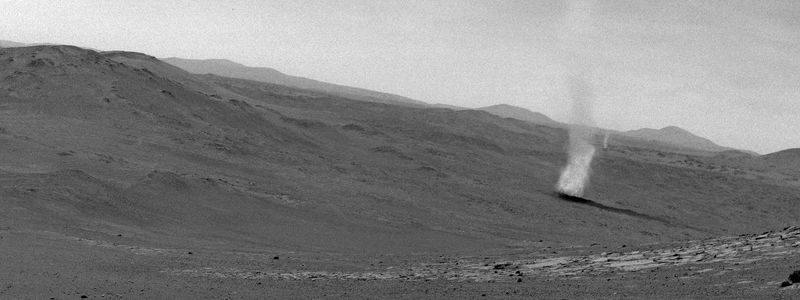
One of NASA's robotic rovers on Mars has for the first time ever detected electrical sparks igniting within small dusty tornadoes whirling on the planet's surface.
While scientists have long theorized that the phenomenon is possible, they've never had proof.
Until now.
Perseverance, the six-wheeled vehicle that has been wandering the rugged terrain of Mars for years, managed to capture dozens of audio recordings of the discharges and their shockwaves within the mini-twisters. The shockwaves are not unlike what NASA referred to in a Dec. 3 blog post as "mini-sonic booms" – a reference to the brief, thunder-like noises that occur when a spacecraft, aircraft or space rocks travel faster than the speed of sound.
“We got some good ones where you can clearly hear the ‘snap’ sound of the spark,” Ralph Lorenz, a Perseverance scientist who co-authored a recent study on the phenomenon, said in a statement.
What's more, the discovery, published Nov. 26 in the journal Nature, "dramatically changes our understanding of Mars" ahead of future astronaut missions to the planet, NASA said in the blog post.
Want to learn more about Martian dust devils, or listen to a sampling of the audio of electrical sparks? Here's everything to know.
What causes Martian dust devils to form?
Dust devils, more officially known as convective vortices, are common features on the surface of Mars that have been regularly observed for decades.
These swirling features are formed by rising and rotating columns of warm air that pick up dust as they begin to spin. Because the Martian atmosphere is so thin, being caught in such a dust devil would feel like being hit by a gust of wind – albeit a dirty one, according to NASA.
Perseverance, which has imaged dusty whirlwinds many times since 2021, famously used its SuperCam microphone to record the first sounds of a Martian dust devil.
But just because dust devils are common doesn't make them easy to capture. Scientists can’t predict when they’ll appear, and when they do, they only last about 10 minutes, so Perseverance routinely monitors in all directions for them.
Mars rover detects electric sparks in mini-twisters
Decades before NASA's Perseverance rover even arrived on the red planet, scientists had suspected that swirling dust devils, similar in a sense to tornadoes, could generate enough friction to set off an electrical charge.
The phenomenon, called the triboelectric effect, is not unlike when someone walks on a carpet in socks and touches a metal doorknob to produce a spark, NASA explained.
“On Mars, the thin atmosphere makes the phenomenon far more likely, as the amount of charge required to generate sparks is much lower than what is required in Earth’s near-surface atmosphere,” Baptiste Chide, a member of the Perseverance science team and a planetary scientist at L’Institut de Recherche en Astrophysique et Planétologie in France, said in a statement.
But it wasn't until Perseverance spent years collecting audio of electrical discharges in dust devils that the phenomenon could actually be confirmed. Since 2021, the rover's SuperCam instrument has recorded the sounds of 55 distinct electrical events, 16 of which took place as dust devils passed directly overhead the robot.
The potential for electrical discharges means Mars' atmosphere can activate chemical reactions that destroy organic molecules on the planet's surface and alter the overall chemical makeup of the atmosphere. That means proof of the electrical discharges should help scientists better understand Mars' potential to be habitable while also helping NASA prepare for future human missions to the red planet, according to the agency.
Listen to the sounds of electrical discharges in Martian dust devils
What to know about NASA's Perseverance rover
NASA's Perseverance rover, along with Curiosity, is one of the agency's two car-sized robots exploring the Martian surface for signs that the planet was once habitable.
Scientists believe the geology of Mars may hold valuable clues about past ancient life, and so the robotic vehicles, controlled remotely from Earth, have slowly navigated the rocky terrain to scoop up and collect intriguing samples. In fact, in September, NASA officials confirmed that one of the rovers’ finds contained a potential biosignature.
After launching in 2020, Perseverance made a 200-day, 300-million-mile journey to reach Mars' Jezero Crater in February 2021. At the end of 2024, after years in the trenches of Jezero, Perseverance summitted the steep Martian crater to begin the next leg of its journey exploring the rim.
Eric Lagatta is the Space Connect reporter for the USA TODAY Network. Reach him at elagatta@gannett.com
This article originally appeared on USA TODAY: NASA rover detects electric discharges like 'mini-sonic booms' on Mars
Reporting by Eric Lagatta, USA TODAY / USA TODAY
USA TODAY Network via Reuters Connect
 America News
 Santa Maria Times Safety
 Spectrum News Louisville
 Reuters US Business
 Just Jared
 Orlando Sentinel Sports
 AlterNet
 NBC10 Boston Entertainment
 The Daily Beast