

 USA TODAY National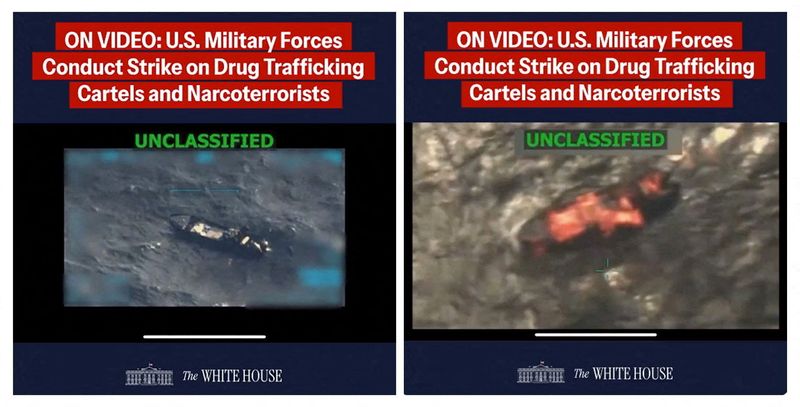
WASHINGTON – President Donald Trump and his top aides have justified lethal military strikes on suspected drug smuggling boats from Venezuela by accusing Venezuela and suspected criminal networks operating on its soil like the Cartel de los Soles of flooding the United States with deadly drugs.
"This mission defends our Homeland, removes narco-terrorists from our Hemisphere, and secures our Homeland from the drugs that are killing our people," Secretary of War (formally Secretary of Defense) Pete Hegseth posted Nov. 13 on X. He said the military mission has been named Operation Southern Spear.
In August, the United States doubled the reward for information leading to the capture of Venezuelan President Nicolás Maduro to an unprecedented $50 million over allegations of drug trafficking and links to criminal groups. Attorney General Pam Bondi explained the bounty at the time by accusing Maduro in a video message of being "one of the largest narco-traffickers in the world and a threat to our national security."
That’s reason enough, Trump and administration officials say, for launching military attacks that have killed at least 87 people in recent months – including two men clinging to wreckage after they survived an initial strike Sept. 2 that killed nine other suspected smugglers. They say it might even warrant an attack on Venezuelan soil, which Trump has implied may be in the offing.
U.S. and United Nations drug data, however, show that Venezuela isn't a producer or exporter of fentanyl, a lab-made synthetic opioid, and that it plays a relatively minor role in the far-less-lethal cocaine trade.
Venezuela does not produce fentanyl
“Every boat kills 25,000 on average − some people say more," Trump told U.S. military generals in September. "You see these boats, they’re stacked up with bags of white powder that’s mostly fentanyl and other drugs, too.”
But Mexico is the primary − and virtually only − mass producer and exporter of fentanyl, with Chinese peddlers sending small amounts by mail, according to the U.N. Office on Drugs and Crime and U.S. counternarcotics organizations.
The opioid, 50 times more powerful than heroin, is almost entirely made with precursor chemicals that originate in China and are used by Mexican drug cartel chemists to make various pills, powders and other products intended for the U.S. market.
According to the Drug Enforcement Administration's 2025 National Drug Threat Assessment and the Office of the Director of National Intelligence's 2025 Annual Threat Assessment, Mexico-based transnational criminal organizations (TCOs), especially the Sinaloa and the Jalisco New Generation Cartel, are the primary suppliers of illicit drugs, including fentanyl, for the U.S. market, the Congressional Research Service said in a briefing paper for lawmakers Aug. 26.
"Within the past six years, Mexican TCOs have acquired the ability to manufacture illicit fentanyl in Mexico," the independent research arm of Congress concluded. "They reportedly use pill presses, often imported from China, to lace counterfeit medication, including veterinary medication, with fentanyl or methamphetamine."
Many victims have been young people taking what they think are other recreational drugs or painkillers that actually contain a potentially fatal dose of fentanyl so small it’s no larger than a grain or two of rice.
Venezuela does play a significant role in the trafficking of cocaine that’s grown and processed in Colombia and elsewhere in Latin America.
But that white powder, popular with recreational drug users in the United States since the 1920s, is driving a small share of U.S. overdose deaths. The Centers for Disease Control found 74,702 of the 107,543 U.S. overdose deaths in 2023 involved synthetic opioids, usually fentanyl.
Though Trump does not seem to distinguish between cocaine and fentanyl, drug overdose deaths from cocaine rose from 12,122 in 2015 to 59,725 in 2023 only because nearly 70% of those more recent deaths involved cocaine mixed with fentanyl, according to the CDC.
What role does Venezuela play in drug trafficking?
Available data suggests Venezuela is not a primary source for U.S.-bound cocaine or other major drugs, especially fentanyl.
Instead, it’s considered mostly a transit hub for cocaine, and a minor one at that, given that most of the drug flowing north from Andean countries are not primarily routed through Venezuelan ports, according to the U.N. Office on Drugs and Crime (UNODC) World Drug Report 2025.
The UNODC and DEA both say most of the world’s cocaine continues to be produced in Colombia, with smaller shares coming from Peru and Bolivia. Some of the trafficking organizations moved at least part of their operations to neighboring Venezuela after Washington’s multibillion-dollar Plan Colombia crackdown in that country.
And Venezuela doesn’t even register a blip on the U.N. report and the latest DEA assessment of fentanyl flows into the United States.
The fentanyl headed for the United States is shipped north from Mexico using a network of smugglers and other facilitators, the DEA report said.
"Since approximately 2019, Mexico has reportedly replaced the People's Republic of China (PRC, or China) as the main source of U.S.-bound illicit fentanyl," the Congressional Research Service's briefing paper said.
That report, and others by the DEA and the United Nations, usually don't mention Venezuela at all when discussing fentanyl flows. The Republican staff of the Senate Homeland Security Committee also left it out entirely in its major 51-page report, "Addressing the Supply Chain of Synthetic Drugs in the United States," in December 2022.
What President Trump is claiming
Opponents of Trump’s policies say the president is conflating the two drugs to claim vast powers as judge, jury and executioner that have been used in the past only against terrorist organizations aiming to kill Americans after the Sept. 11, 2001, al-Qaida attacks that killed nearly 3,000 people.
By doing so, legal experts say, the strikes raise increasingly urgent – and unresolved − questions about whether Trump is violating domestic and international law.
Trump and senior officials frame Venezuela as a “narcoterrorist” state whose government-affiliated criminal networks pose a national security threat to the United States.
The administration has designated Venezuela’s criminal gang Tren de Aragua and the Cartel de los Soles − a loose network of corrupt military officials accused of trafficking drugs – terrorist organizations under Executive Order 14157.
That order, issued in January, is formally titled "Designating Cartels and Other Organizations as Foreign Terrorist Organizations and Specially Designated Global Terrorists." It is designed to sanction transnational cartels that “constitute a national security threat beyond that posed by traditional organized crime.”
The order led Secretary of State Marco Rubio to claim Aug. 8 that it gives the administration the authority to treat those designated cartels – presumably even the small-boat smugglers suspected of carrying cocaine rather than fentanyl – as “armed terrorist organizations, not simply drug-dealing organizations.”
Trump has gone even further rhetorically.
After Republican Sen. Rand Paul of Kentucky went public with his concerns that the attacks amounted to illegal “extrajudicial killings,” Trump said his administration would be willing to brief lawmakers on the strikes.
But on Oct. 23, Trump said he saw no reason to seek congressional authorization for them.
Instead of asking for a "declaration of war" from Congress, Trump said, "I think we’re just going to kill people that are bringing drugs into our country. … They’re going to be, like, dead.”
And, Trump said, “the land is going to be next.”
Trump also has cited a 2020 Justice Department indictment from his first term that accused Maduro of collaborating with the Colombian left-wing guerrilla group FARC to use cocaine as a weapon against the United States.
“On the campaign trail, President Trump promised to take on the cartels – and he has taken unprecedented action to stop the scourge of narcoterrorism that has resulted in the needless deaths of innocent Americans," Deputy White House Press Secretary Anna Kelly told USA TODAY. "All of these decisive strikes have been against designated narcoterrorists bringing deadly poison to our shores, and the president will continue to use every element of American power to stop drugs from flooding into our country.”
Do Venezuelan criminal groups traffic drugs?
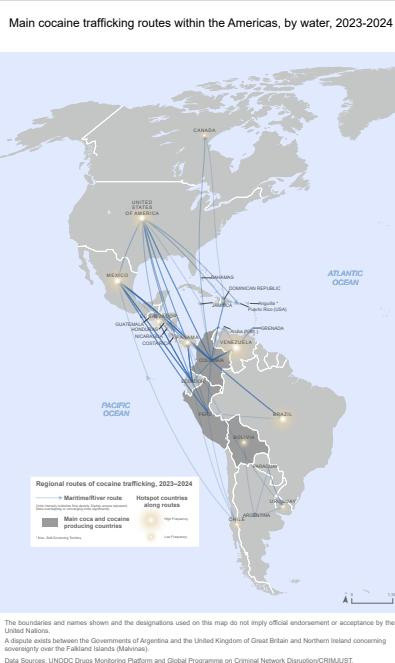
Cocaine typically moves north from Colombia through Central America and onward via the maritime transit routes in the eastern Pacific and the Caribbean.
A very small percentage of cocaine does pass through Venezuela, particularly for shipments headed toward the Caribbean and Europe, according to UNODC trafficking maps. But the maps show virtually none of that cocaine leaving Venezuelan shores is headed for the United States.
Instead, maritime routes skipping Venezuela entirely historically have been far more dominant in getting cocaine to Mexico, where the cartels there smuggle them into the United States through various means.
Cartel de los Soles has for the past several decades been involved in various corrupt activities, including cocaine trafficking, usually with FARC.
Justice Department indictments have targeted Maduro and some of his top aides, both in the civilian government and the military, including former Vice President Tareck El Aissami, Diosdado Cabello Rondon and Hugo “El Pollo” Carvajal Barrios.
Tren de Aragua, long vilified by Trump, is involved in many crimes, including extortion, racketeering, drug and human trafficking conspiracy, and firearms offenses.
In his campaign for president last year, Trump repeatedly warned about the threat of Tren de Aragua to U.S. communities − and used its connections to some low-level crime to strengthen his call for mass deportations of undocumented immigrants from Venezuela.
The group’s many offshoots are considered by some U.S. officials to be violent and influential regionally. But available international drug tracking data does not support claims that they are significantly involved in cocaine smuggling into the United States.
There is also conflicting evidence about whether the group even works with Maduro, as the Trump administration claims, or against his regime.
In July, Maduro stated at a police ceremony that Venezuela had “finished off Tren de Aragua.”
And Venezuelan Foreign Minister Yván Gil declared in 2024 that Tren de Aragua no longer existed, according to InSight Crime, a think tank and media organization specializing in investigating organized crime in the Americas.
“We have demonstrated that the Tren de Aragua is a fiction created by the international media to create a nonexistent label,” Gil reportedly said.
This article originally appeared on USA TODAY: Trump says Venezuela sends US lethal drugs, but data tells different story
Reporting by Josh Meyer, USA TODAY / USA TODAY
USA TODAY Network via Reuters Connect

 CNN
CNN Salon
Salon Raw Story
 AlterNet
 Associated Press Top News
 The Philadelphia Inquirer Crime