

 The Conversation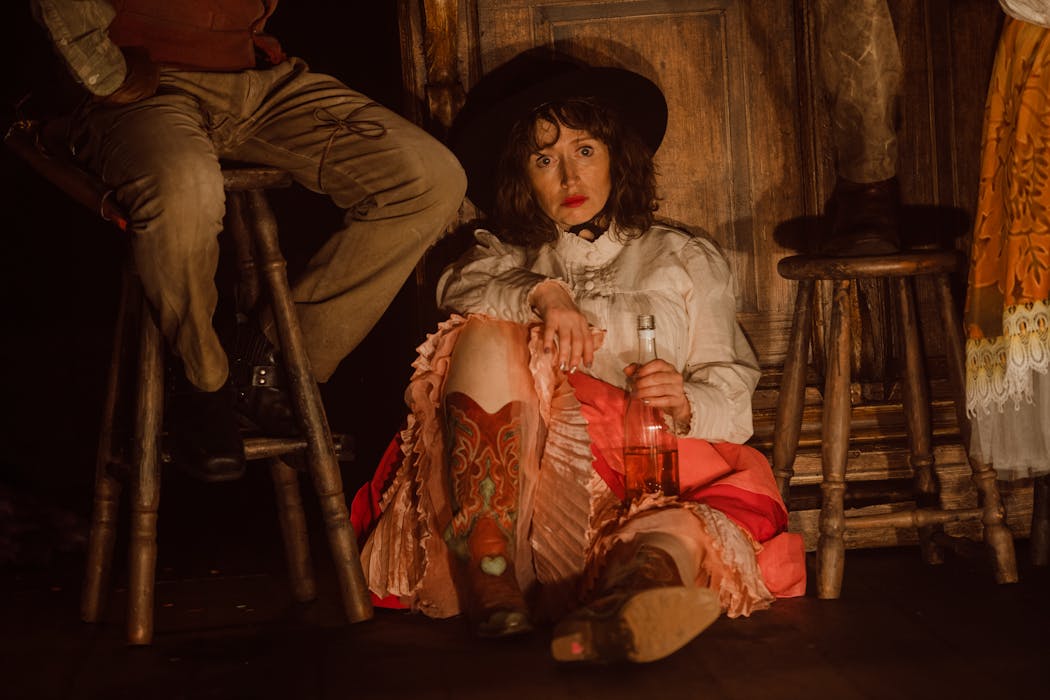
Music and theatre can bring into the world places and stories that exist only in the imagination. Can music and theatre also change hearts and minds?
This question is at the heart of Cowbois, a new music theatre piece written by Charlie Josephine and directed by Kate Gaul.
Cowbois reimagines a Hollywood-esque Wild West where rugged individuality and hyper masculinity are challenged and eventually replaced by joy, freedom and resistance. It dreams forward towards a utopian vision, where hope and desire can be forces for change.
Challenging community
Cowbois opens with a group of women in a saloon waiting for the return of the men of the community, who have gone off in search of gold.
Into this collective of women comes the transmasculine fugitive Jack Cannon (non-binary performer Jules Billington, with a swagger reminiscent of Elvis with a touch of Bowie). He is a legendary bandit famed for his song and voice, charisma and legendary lawlessness.
Jack develops a passionate relationship with Miss Lillian (Emily Cascarino), the bar owner, that results in a magical pregnancy.
Jack’s presence is the catalyst for Lucy/Lou (Faith Chaza) and Sheriff Roger (Mathew Abotomey) to experiment with their gender expression: the Sheriff with cross dressing and Lou with their own version of extravagant cowboy dress. We see both characters’ emerging power and confidence challenged – at times violently – by the return of the men.

The men arrive without the promised gold but wanting to re-exert their control over a community that has dramatically changed in their absence. The atmosphere of threat and potential violence lead to a backsliding where Lou and Sheriff Roger grudgingly and fearfully put on their old masks.
The kid (Beau Jenkins) disarms the returning men with his unquestioning acceptance of Lou and the Sheriff’s transformations, and the men, in turn, face their own behaviour.
Change is afoot when a gun fight sees the collision of several opposing forces (including bounty hunters), forcing each character to pick a side. This community finds its place with each other and the hostile outside world.
Cowbois’ use of music, song and dance present a subversive, fantastical epiphany.
The music – bluegrass, blues and pop – places us in a world that is neither the Wild West nor now, but somewhere that speaks to both. It is full of wild possibilities where transgender and non-binary characters drive the action in a joyous, extravagant romp reminiscent of old style movie musicals.
The dramatic entrance of the bounty hunters through the middle of the audience is a gloriously silly touch.
Queering music theatre
Musicals and theatre have always had space for queer creatives, it just hasn’t always had space for their stories.
Musicals are moving away from coded and two-dimensional representations of queerness towards more authentic representations of gender diversity.
But there are still few opportunities for transgender and non binary performers and characters to be seen on music theatre and theatre stages – let alone in chaotic, wild and celebratory stories like Cowbois.
Cowbois draws on real-life figures to populate this world. Charlie Parkhurst (Clay Crighton), who arrives all leers and menacing guffaws, was a real stagecoach driver and legendary character of the Wild West and also a transgender man.

Much of the image we hold in our minds of cowboys is made in myths. Many cowboys were Black, Hispanic (Vaqueros) and Native American and most didn’t carry guns. The work was hard and gruelling and attempts to form a union were met with violent opposition by landowners.
In creating this work, Josephine was interested in exploring “masculinity and the truth of that”. Through conversations with men and non-binary people about the enforced rules of masculinity, he concluded: “Patriarchy is squashing everyone.”
The musical has often not done transgender and non-binary characters any favours in their representation (or absence). Here the transgender and non-binary characters are fully fleshed out and the central protagonists of the piece.
Josephine has spoken about the importance of seeing characters like him on stage or screen and that working class and queer stories were equally absent in the stories he saw growing up.
In Cowbois, Josephine is trying to redress this imbalance.
Cowbois plays with music and theatre and creates something that is neither a musical nor a play but an evolution of both: a subversive opposition that is full of joy and optimism.
Cowbois, from Seymour Centre and Siren Theatre Co, plays Sydney until December 13.
This article is republished from The Conversation, a nonprofit, independent news organization bringing you facts and trustworthy analysis to help you make sense of our complex world. It was written by: Karen Cummings, University of Sydney
Read more:
- How we created new Noongar song and dance for kworlak – the bull sharks of Perth
- ‘It’s wanting to know that makes us matter’: how Tom Stoppard made us all philosophers
- Nothing much comes of nothing in Belvoir’s new version of King Lear
Karen Cummings does not work for, consult, own shares in or receive funding from any company or organisation that would benefit from this article, and has disclosed no relevant affiliations beyond their academic appointment.


 Raw Story
 The Babylon Bee
 America News
 NBC News
 Just Jared