

 Gizmodo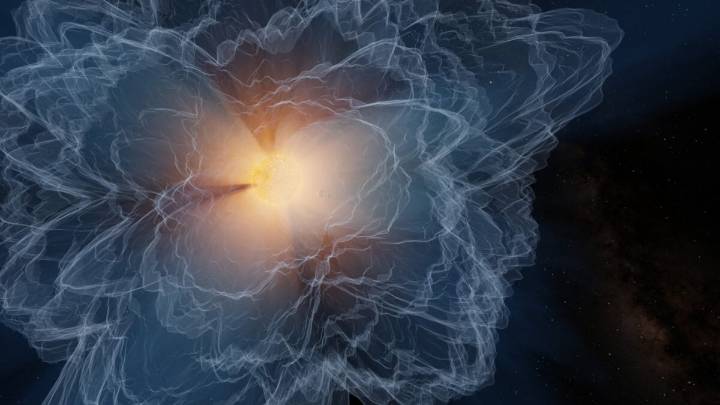
Stars are lively, often unpredictable parts of the universe, and many aspects of their physics remain poorly understood. That includes our own Sun, whose fickle weather patterns regularly tamper with Earth’s magnetic fields. But a new, first-of-its-kind map of the solar boundary may hint at some answers to the Sun’s many mysteries.
Astronomers led by the Center for Astrophysics | Harvard & Smithsonian (CfA) created the first continuous 2D maps of the Sun’s outer surface—a comprehensive picture of a “spiky, frothy” world fraught with solar winds, plasma, magnetic waves, and other stellar phenomena. The map, announced in a paper published today in The Astrophysical Journal Letters , was compiled from Parker Solar Probe’s data on the Sun’s surface and later refined using additional close
 NewsNation
 Reuters US Business
 Women's Wear Daily Lifestyle
 Foreign Policy
 CNN Politics
 Raw Story
 The Daily Beast
 Political Wire