

 Reuters US Economy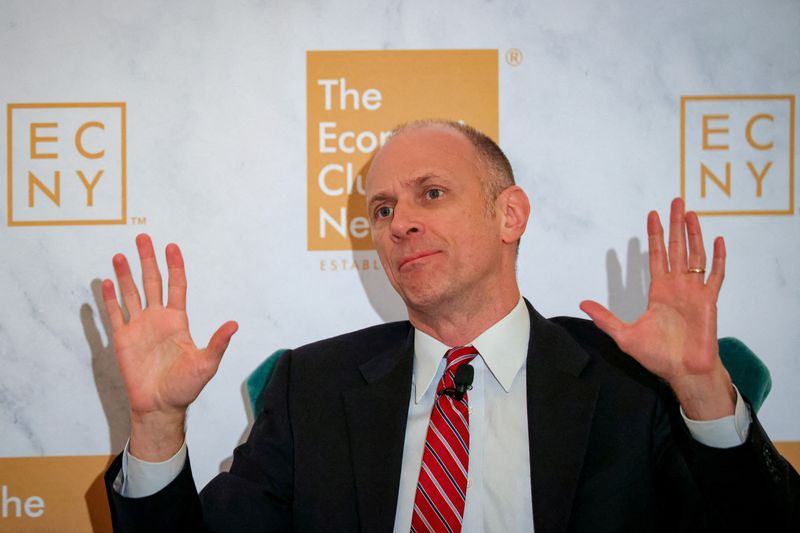
By Howard Schneider and Michael S. Derby
WASHINGTON, Dec 12 (Reuters) - Federal Reserve officials who voted against the U.S. central bank's interest rate cut this week said on Friday they are worried that inflation remains too high to warrant lower borrowing costs, particularly given the lack of recent official data about the pace of price increases.
Chicago Fed President Austan Goolsbee said in a statement that he dissented against the quarter-percentage-point rate cut because he felt it was better to wait for more data about inflation and the state of the job market before lowering borrowing costs, particularly given the intense concern businesses and consumers still express about rising prices.
Waiting until early next year to cut rates, Goolsbee said, would have given policymakers the benefit of updated government data, with key reports coming next week, while entailing little additional risk to a job market that appears to be "only moderately cooling."
"We should have waited to get more data, especially about inflation," said Goolsbee, who issued one of three dissents in the Fed's 9-3 vote on Wednesday to lower its benchmark interest rate to the 3.50%-3.75% range following the end of a two-day policy meeting.
Key government data on the job market and inflation is still lagging after the 43-day federal government shutdown in October and November.
Kansas City Fed President Jeffrey Schmid also dissented on Wednesday in favor of holding the policy rate steady, while Fed Governor Stephen Miran again argued for a larger half-percentage-point cut.
"Waiting to take this matter up in the new year would not have entailed much additional risk and would have come with the added benefit of updated economic data which have been absent lately," Goolsbee said.
"Given that inflation has been above our target for four and a half years, further progress on it has been stalled for several months, and almost all the business people and consumers we have spoken to in the district lately identify prices as a main concern, I felt the more prudent course would have been to wait for more information," Goolsbee added.
"There is little to suggest a deterioration of the labor market so rapid that we could not have waited for the data to come in the early months of next year before deciding to act," said Goolsbee, who also said he was still "optimistic" that rates could come down next year "by a significant amount" if incoming data shows inflation returning to the Fed's 2% target.
ABOVE-TARGET INFLATION
Schmid, in a statement, said he dissented because inflation is "too hot" and monetary policy should remain modestly restrictive to keep it in check.
"Right now, I see an economy that is showing momentum and inflation that is too hot, suggesting that policy is not overly restrictive," he said. Schmid added that in his view not much had changed since he dissented against the Fed's rate cut in October, with inflation above target and the labor market "largely in balance."
The most recent official data on unemployment and inflation is for September, and showed the unemployment rate rising to 4.4% from 4.3%, while the Fed's preferred measure of inflation also increased slightly to 2.8% from 2.7%. The pace of price increases has risen steadily from 2.3% in April, a fact at least partly attributable to the pass-through of rising import taxes to consumers and a driving force behind the central bank's policy divide.
Goolsbee and Schmid will rotate out of their voting roles on the rate-setting Federal Open Market Committee next year.
Philadelphia Fed President Anna Paulson, who will move into a voting role, said on Friday she remained worried about job market weakness.
"On net, I am still a little more concerned about labor market weakness than about upside risks to inflation," Paulson said in remarks prepared for an event hosted by the Delaware State Chamber of Commerce in Wilmington. "That's partly because I see a decent chance that inflation will come down as we go through next year" with the waning of tariff impacts, which have been the main driver of price pressures overshooting the target this year.
(Reporting by Howard Schneider; Editing by Chizu Nomiyama and Paul Simao)

 KFVS12 Crime
 ABC 7 Aurora
 Essentiallysports Golf
 Raw Story
 America News
 Verywell Health