

 Reuters US Economy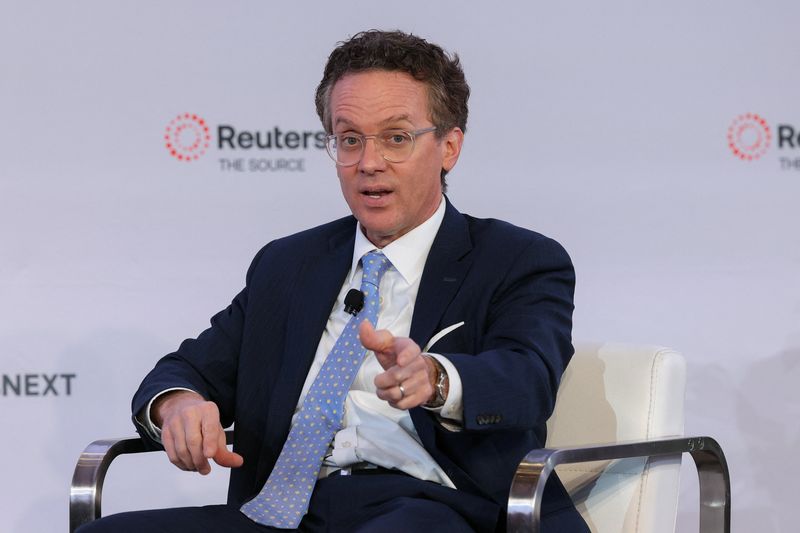
By David Lawder and Andrea Shalal
NEW YORK, Dec 3 (Reuters) - Lower interest rates would likely eliminate the need for a 50-year mortgage floated by President Donald Trump to boost housing affordability, Joseph Lavorgna, a counselor to U.S. Treasury Secretary Scott Bessent, said on Wednesday.
Lavorgna said at the Reuters NEXT conference in New York that the idea of a 50-year mortgage was not necessarily officially off the table, but described it as a proposal from the Federal Housing Finance Agency to try to lower monthly mortgage payments. The problem with the housing market is that interest rates are too high because of the Federal Reserve's cautious approach to lowering them, he added.
"We won't need a 50-year mortgage if the Fed was lowering its rates, which I think it will," Lavorgna said, "but it's been, I think, very slow and uneven on that score."
Lavorgna, who served a one-year stint during Trump's first term, said he agreed that monetary policy had been too tight, hitting housing and other sectors of the economy, but he said that a further drop in rates could provide a boost.
"If the Fed can actually lower rates and get rates to neutral, if not somewhat stimulative ... then you're going to get mortgage rates down," he said.
Lavorgna conceded that Americans were concerned about the economy, but said he was confident that the Trump administration's policies, including deregulation, changes in tax policy and a big boost in capital investment, would increase hiring, productivity and economic growth next year.
Trump has focused heavily on lowering Americans' cost of living, including through rollbacks of tariffs on food products, amid declining poll numbers and some election setbacks for his Republican Party in state and local elections.
One critical element, Lavorgna told Reuters NEXT, would be new rules that will allow companies to write off the expense of building a factory - not a data center - over three years instead of nearly 40 years under current rules.
"That's really positive for growth, and that's going to increase the supply side of the economy over time. That will also tend to lower inflation," he said.
Working Americans would see the benefit of new rules limiting taxes on overtime and tips next year, beginning in the first quarter, he said.
Lavorgna said he was predicting 3% growth next year, with low and falling inflation, aided by falling rents and lower energy costs, especially for gasoline.
"Let's talk a year and see what happens. So we're going to get there, it just might take us a little bit longer," he said, saying data indicated that the U.S. economy had grown by 4% in the third quarter. "This is why I'm saying 'just be a little patient here.'"
Lavorgna also noted that $2,000 rebate checks funded by tariff revenue - another proposal floated by Trump in recent weeks - would require congressional approval and said it was unclear if that could happen.
"I'm not sure where that sits at the moment. Depending on who you talk to in the Congress, there would be a reconciliation bill, (or) there won't," he said. "As the year concludes and we go into 2026, I don't necessarily think we'll need that if the growth backdrop is as strong and robust as I believe it will be."
Asked about Trump's suggestion that tariff revenue could eventually eliminate the need for a federal income tax, Lavorgna called it an "innovative idea."
Lavorgna also challenged the widely held view that tariffs are inflationary, calling it "economic malpractice" and saying that any impact, if it occurred, would be a one-off price-level adjustment and "very de minimis."
"We've seen the vast majority of the tariffs be absorbed in margins," he said, adding that foreign exporters had also lowered prices to avoid hitting consumers.
View the live broadcast of the World Stage here and read full coverage here.
(Reporting by Andrea Shalal and David Lawder; Editing by Chizu Nomiyama and Matthew Lewis)

 Martinsburg Journal
 Rockford Register Star
 Battle Creek Enquirer
 New York Post Opinion
 Deseret News
 New York Post Business
 Newsday
 The Atlantic
 KKTV 11 News
 Week | 25 News Now
 Associated Press US News