

 USA TODAY National
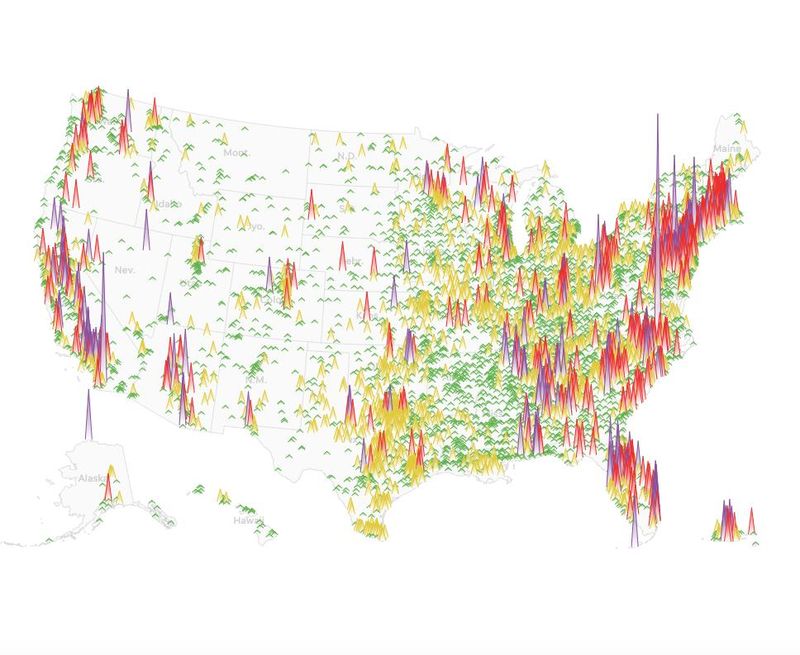
Drinking water for at least 1 of every 7 Americans – about 49.5 million people – contains unsafe levels of “forever chemicals,” according to new test results the Environmental Protection Agency published in November.
Since the EPA last updated these records in August, over 100 additional public drinking water systems have reported yearly averages of PFAS, or per- and polyfluoroalkyl substances, that exceed new limits the EPA approved in 2024.
USA TODAY’s analysis of the records shows water utilities in Anaheim and San Jose, California, and Brownsville, Texas, have now joined the 944 systems scattered across the country that have recently failed to meet the new EPA standards.
MAP: Where water systems reported PFAS contamination
Click on a system in the map below to review its PFAS measurements. You may also enter an address in the search box to locate the nearest water systems. Don't see a map? Click here.
There are thousands of types of PFAS chemicals, which are nearly indestructible because they were engineered to repel liquids and heat. Scientists say they can accumulate in the human body and can increase the risk of certain cancers and other health problems when ingested.
The EPA originally limited six types of PFAS in drinking water under the Biden administration, but it announced it would rescind all but two of those limits in May.
The count of municipalities not meeting these two limits is likely to grow as the EPA wraps up a three-year initiative that required all public utilities serving at least a few thousand customers to check for forever chemicals in their drinking water.
What’s new in this updated EPA data?
Drinking water samples collected in Anaheim, California, between November 2024 and May 2025 show one city well averaged 17 parts per trillion (ppt) for PFOS and 8 ppt for PFOA, respectively four times and two times over both chemicals’ limit of 4 ppt.
Samples that the Brownsville Public Utilities Board in Texas collected from two water treatment plants from July 2024 through April 2025 averaged slightly over the PFOS limit, while the California Water Service Company in San Jose reported one well whose yearly average of PFOS measured double the limit from January through July 2025.
Places like these whose measurements continue to average over the PFAS limits will need to locate other sources of drinking water for their customers or install filtration systems within the next few years. The deadline was originally set for 2029, but the EPA has also announced it will extend that deadline.
Although Anaheim’s records were recently added to the EPA’s data set, the city has known about PFAS contamination in its water since at least 2019, when it notified residents about the problem.
“What we are encountering is believed to be remnant traces from consumer products and factories, military bases and other industrial uses all around us in southern California,” the city wrote on its website.
Anaheim is spending $200 million to outfit several of its groundwater wells with ion exchange filtration – a technique that uses resin beads to snare and remove particles from water, according to the city website. Construction is slated to finish in 2027.
In Brownsville, the Public Utilities Board is currently collecting more data and evaluating next steps, according to spokesperson Alexa Perez.
”This additional data will help us evaluate potential treatment options, operational adjustments, and any future infrastructure needs,” Perez wrote by email, noting that they would seek state or federal grants if necessary. “We do not yet know if there would be an increase in rates to our customers.”
What’s happening with the lawsuit challenging these PFAS limits?
The Infrastructure Investment and Jobs Act of 2021 made about $1 billion in EPA grants available each year for disadvantaged and small communities to mitigate “emerging contaminants” like PFAS, but as Anaheim’s project shows, these construction projects can be quite expensive.
Some water utilities have told USA TODAY they’ve had to raise water rates to meet the new EPA standards, which many utilities argue isn’t fair since manufacturers created the pollution.
That’s part of the reason industry groups representing water utilities sued the EPA in 2024, claiming the agency did not follow proper procedures when approving the new PFAS limits. The lawsuit was put on hold as the Trump administration took over the agency at the start of 2025, but in September, the EPA formally asked the court to invalidate four PFAS limits it approved in 2024.
“EPA has now determined that its decision … was inconsistent with the statute, and EPA no longer seeks to defend the relevant portions of the rule,” EPA lawyers wrote in a Sept. 11 legal filing.
Two weeks later, environmental advocates campaigning to keep the four PFAS standards the EPA now wants to abandon submitted their own legal filing to the court. They allege vacating these four limits would risk the health of millions of Americans and disrupt water utilities that have already invested millions of dollars to comply with them.
“[It] would accomplish an end run around Congress’s purposeful prohibitions against agency flip-flopping on protections for the nation’s drinking water,” the environmental advocates wrote in their legal filing.
The lawsuit was paused during the six-week government shutdown, but now that it’s resumed, the EPA, water utility industry groups and environmental advocates all are expected to submit additional legal filings this month.
This article originally appeared on USA TODAY: Are there forever chemicals in your water? Here's the latest data.
Reporting by Austin Fast, USA TODAY / USA TODAY
USA TODAY Network via Reuters Connect

 AlterNet
 People Human Interest
 13 On Your Side
 Verywell Health
 The Conversation
 NBC News
 CNN Health
 Raw Story