

 Cover Media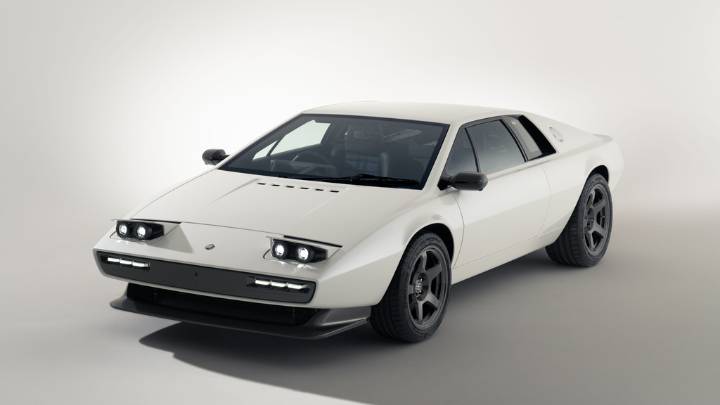
Fifty years after the original Lotus Esprit concept stunned crowds at the 1975 Paris Motor Show, it's returning to British roads.
That's because UK firm Encor has revealed the Encor Series 1 - a carbon-fibre remaster of the Esprit designed to preserve and elevate one of the most recognisable silhouettes in automotive history.
It owes some of its fame to its appearance in the 1977 James Bond film The Spy Who Loved Me, in which the car famously converted into a submarine after a road chase. The specific car used in the underwater scenes, nick-named "Wet Nellie", was bought by Elon Musk in September 2013.
The Series 1 embodies what Encor calls "respectful enhancement". Rather than reinventing the Esprit, the design and engineering team - with experience from Lotus, Aston Martin, Koenigsegg and Skyships Automotive - approached it as an artefact of cultural significance. Their aim was to remaster the car using modern craftsmanship and capability without disturbing the purity that defined the original.
"The S1 Esprit was forward-thinking, pure and utterly uncompromised," says Daniel Durrant, Encor's Head of Design and former Lead Designer at Lotus for the Emira. "To touch a shape like this is a huge responsibility. Every line we've refined, every decision we've made, is about honouring the original's intent while letting the car perform, feel and function the way its silhouette always promised."
Durrant's team began by digitally scanning the original Esprit, resurfacing and refining its geometry using contemporary design tools. The goal was to sharpen the form: tighter highlights, cleaner transitions and more precise surfacing. The distinctive two-piece mould line of the 1970s fibreglass body has been eliminated, replaced by a single autoclaved carbon-fibre shell that channels the purity of the earliest design sketches.
Even the wheels have been reimagined with reverence. Drawing inspiration from the original slot-mag design and the later Sport 350 five-spokes, Encor's forged and billet-machined wheels reinterpret familiar cues with modern proportion and clarity.
Underneath the carbon body lies the chassis of a Lotus Esprit V8, retained deliberately for continuity of identity and registration. The frame is stripped, cleaned and refinished before being paired with a fully reconstructed powertrain. The mid-mounted 3.5-litre twin-turbo V8 now features forged pistons, upgraded injectors, remanufactured turbochargers, a new electronic throttle body, refreshed fuel and cooling systems and a new stainless-steel exhaust.
Output now stands at around 400 bhp and 350 lb ft of torque, pushing a target kerb weight of under 1,200 kg. Encor expects 0-62 mph in about four seconds and a top speed close to 175 mph.
Inside, the Series 1 retains the Esprit's defining features: the steeply sloped dashboard, wraparound instrument binnacle, tartan details and deep-set cockpit feel. Each element, however, has been rebuilt from its foundations.
A new instrument cluster - machined from a single aluminium billet and wrapped around a modern digital display - becomes the cabin's centrepiece, offering clarity and craftsmanship unimaginable in 1975. A carbon-fibre dashboard "T" houses essential controls, while seats have been restored and retrimmed with improved support.
Production of the Encor Series 1 will be limited to 50 individually commissioned cars worldwide.
Prices begin at £430,000, excluding taxes, options and the required donor Esprit V8. Commissioning will take place at Encor's Chelmsford headquarters or via private consultation for international buyers. Deliveries are scheduled to begin in the second quarter of 2026 and continue through 2027.

 People Books
 ScienceAlert en Español
 @MSNBC Video
 AlterNet
 The Shaw Local News Sports