

 AlterNet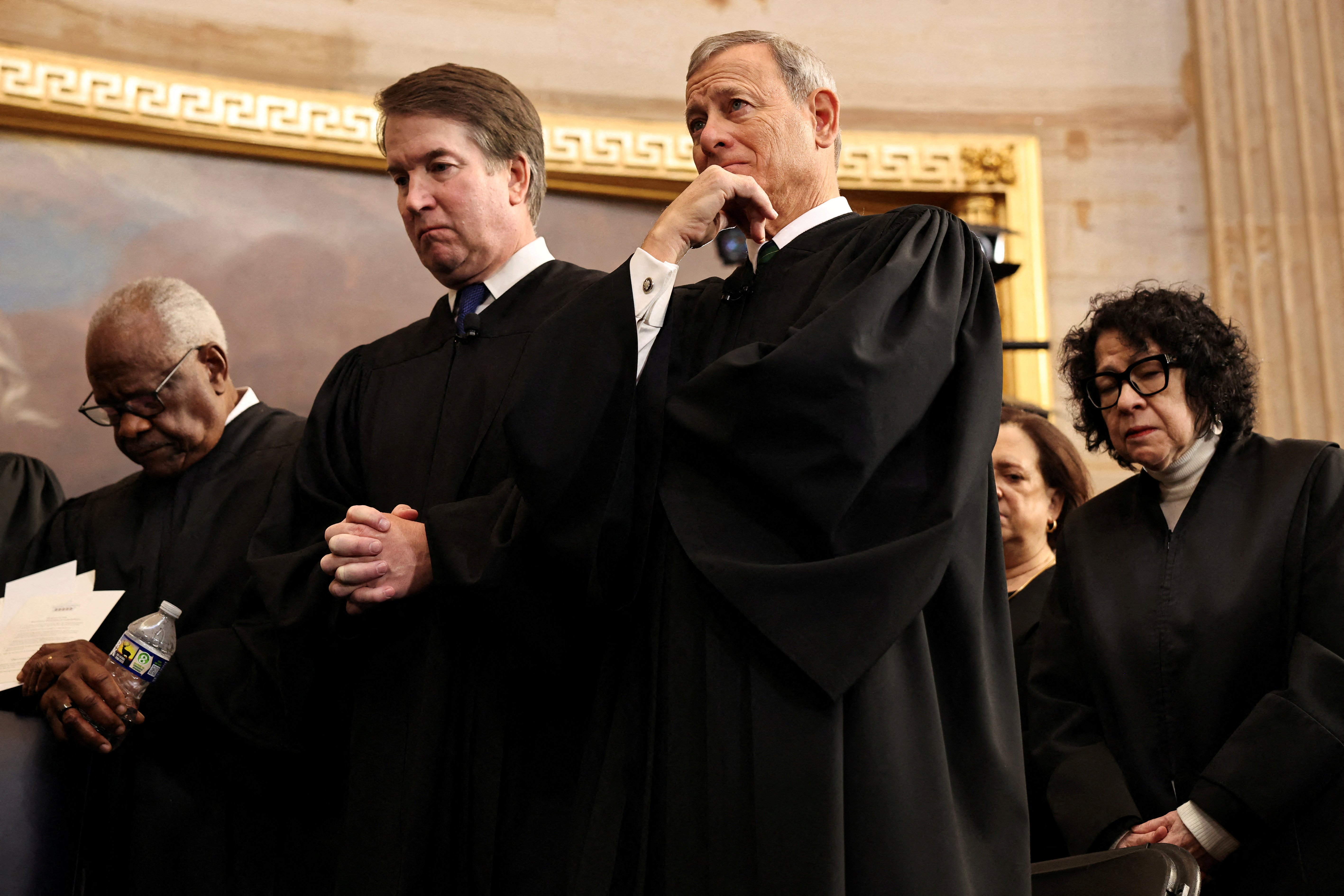
Earlier this year, the U.S. Supreme Court dodged consideration of the constitutional right to citizenship allotted to those born on American soil. Rather than striking down the guarantees in the 14th Amendment, the high court ruled that nationwide injunctions were the problem in this case. Now that they intend to take a crack at birthright citizenship, some legal experts are growing nervous and annoyed.
"It cannot be said enough, and should be shouted from the rooftops: this is a fake legal issue that's been backstopped by on-demand scholarship from academics who are part of the same project as the conservative justices. The 'authority' they will cite is no better than citing AI slop," blasted civil rights lawyer Joshua Erlich on Bluesky.
Maryland attorney Joe Dudek posted, "This was inevitable, but I do wish they had just refused to even entertain it."
Lawyer Sean Marotta related the law to Obamacare, saying, "The Birthright Citizenship case reminds me of the endless post-NFIB cases where we had to, as a society, sit through 'omg they're going to kill the ACA!' anxiety annually, and they never did, but it's really unnecessary that we got to this point."
Fordham University law professor John Pfaff wrote: "Counterpoint: The Supreme Court lacks the authority to change the text of the Constitution. So either it affirms the text or (further, and more completely) nukes its authority as Constitutional arbiter. There’s no third option. Art III (courts) can’t just usurp Art V (amendments)."
However, Georgetown Law School Professor Steve Vladeck argued for optimism.
"I understand, as well as anyone, why folks are cynical about SCOTUS. But even from the conservative justices' perspective, the birthright citizenship case is easy," he wrote on Bluesky. "And the Justice Department knows it, too; as I wrote in September, its behavior in these cases has just been going through the motions."
"If anything, ruling against the Trump administration may feel to some of the Republican appointees as a means of buying credibility: 'look how we don't just rule for him in lock-step.' But they can't get that from denying certiorari."
This is the only case without a procedural issue, he argued.
"This is going to provoke a lot of replies (to which I'm not going to respond) about how 'the same people said Roe wouldn't be overruled,' and 'the same people said they wouldn't give Trump immunity.' Leaving aside that that *wasn't* me, there's still lots of evidence for this case being different," he continued.
First, "The justices' behavior at argument (with Kagan, Barrett, and Gorsuch all focused on ensuring the [solicitor general] would appeal a loss so that the merits *would* come back to the Court); and 2) The [solicitor general's] behavior since then, which is most pointedly *not* trying to win on any ground," he closed.
Attorney and Trump foe Norm Eisen, who has been coordinating with several organizations on the case, commented that thus far they "have won at every level and we will have a strong case at SCOTUS as well. We are fighting for the babies, their parents--and the Constitution!"
Constitutional law scholar and professor Anthony Michael Kreis pointed to a piece in the Cornell Law Review he penned with Northwestern Law Professor Paul Gowder and Northern Illinois University College of Law associate professor Evan Bernick.
In it, they examine, among other things, "the professional responsibility of legal scholars to engage in rigorous, fact-based historical analysis rather than politically motivated reinterpretations that threaten to destabilize fundamental constitutional rights."

 Local News in Pennsylvania
 Local News in D.C.
 America News
 Raw Story