

 The Atlantic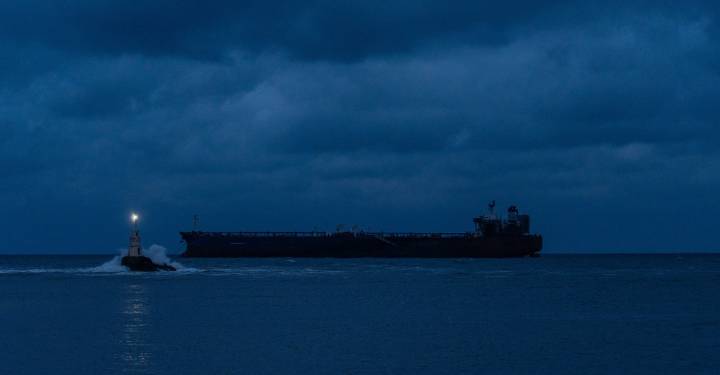
On a warm night in August 2023, Oleksandr Kubrakov, then a senior minister in Ukraine’s wartime government, had just settled into a sleeper car on the eastbound train from Lviv to Kyiv when he got a call from the country’s main intelligence agency, the SBU. Its agents had deployed a set of naval drones in the Black Sea, and they had come upon an interesting target: a massive oil tanker near the Russian port of Novorossiysk. They asked for permission to sink it.
“I told them, ‘Hang on,’” Kubrakov told us. “‘What flag is it flying?’” The drone’s night-vision camera made it difficult to tell, but the flag was clearly not Russian. “That’s not our target,” Kubrakov recalled telling the officer. “That would be piracy. Those are not our methods. We don’t touch civilian vessels, especially those flying some other flag.”
The drones pulled back to continue hunting for Russian warships. For more than two years, Ukrainian forces stuck to that principle. They treated Russian naval vessels as fair game, damaging or destroying dozens of them, including one Russian tanker used to supply the military. But they spared civilian boats, even those carrying Russian oil from Russian ports to finance the Russian war on Ukraine.
Only in the past two weeks has Ukraine set aside those rules of engagement. Amid the latest U.S. push to end the war through diplomacy, explosions hit four oil tankers in six days. The targets were part of the so-called shadow fleet, which Russia uses to transport crude, in violation of Western sanctions. Two of the attacks took place near Ukrainian shores in the Black Sea, and another two struck farther away: one near the northern coast of Turkey and another on the western coast of Africa. The SBU told us it was responsible for the first two attacks and declined to comment on the other two.
Through the summer and fall, the SBU and other branches of Ukraine’s armed forces have also been using long-range drones to hit energy infrastructure inside Russia, targeting oil refineries in particular. But the strikes on oil tankers in international waters mark a dramatic expansion of this campaign, timed to influence the latest American push to end the war.
About a week before the first tanker was struck, in late November, the Trump administration pushed Ukraine to accept a 28-point peace deal full of Russia’s most onerous demands. President Volodymyr Zelensky refused, and his envoys managed to soften the terms during several rounds of talks with the Americans. But the diplomatic pressure on Zelensky made him eager to show the military cards he can still play against the Russians.
Ukraine’s attacks on the shadow fleet achieved that. They also showed how Donald Trump’s peace efforts could provoke a widening series of attacks and counterattacks, as both sides seek to maximize their leverage before sitting down for talks. Until now, Ukraine has avoided striking civilian ships in international waters, because the risks appeared unacceptably high for the environment, for global energy markets, and for Ukraine’s economy.
Vladimir Putin highlighted those risks in his response to the latest strikes. “What the Ukrainian armed forces are doing now is piracy,” the Russian leader said in televised remarks on December 2, the day the fourth tanker was hit. He warned that Russia could retaliate by sinking ships that transport grain, metals, and other goods from Ukrainian ports, including ships that belong to Ukraine’s trading partners. “The most radical solution is to cut Ukraine off from the sea. Then piracy will be impossible in principle,” Putin said. If the Russians make good on that threat, the fighting could yet intensify and spread far beyond the territory of the warring sides.
Under the Biden administration, the United States took a hard line against Ukraine’s attempts to degrade the Russian oil industry, partly out of fear that such attacks could start a cycle of escalation that would intensify the war. Disruptions to the global oil supply also could have led to higher gasoline prices, which weakened Joe Biden’s chances of reelection. Since Trump took office in January, the U.S. has taken a more permissive stance, in some cases providing Ukraine with intelligence and targeting for strikes against energy infrastructure inside Russia, according to senior U.S. and Ukrainian officials with direct knowledge of these efforts.
The White House declined to comment on the recent strikes on Russia’s shadow fleet. But the Trump administration has not objected to these strikes, a U.S. official told us. Though Trump has often been deferential toward Putin, he has endorsed Ukrainian efforts to degrade Russia’s energy economy. He has signed off on moves to help Ukraine target oil refineries deep within Russia, and he approved sanctions in October against Russia’s two largest oil companies.
At this stage in the war, even Kubrakov believes the escalation makes sense. “Just like sanctions, this could make Putin wake up and sit down to talk,” he told us. “The main question is how systematically we can do this.” If Ukraine can use force to stop Russia from shipping oil around the world, he said, “that would be a strong move.” But Ukraine would also need to survive the blowback, both from its allies and from its enemies.
In the early months of the invasion, in 2022, the Russians tried to suffocate Ukraine’s economy by imposing a naval blockade of its ports. About 20 million tons of grain got stuck in the port city of Odesa, causing global food prices to spike and raising fears of famine in parts of Africa and the Middle East that rely on supplies from Ukraine.
That summer, the United Nations brokered a deal to allow cargo ships to transport food and other goods from Ukraine across the Black Sea. Kubrakov, then serving as the minister of infrastructure, helped negotiate that agreement. It held for about a year before Russia pulled out, in July 2023, and resumed its blockade. By then, the Ukrainians had developed a small fleet of naval drones—remote-controlled motorboats that could be packed with explosives and steered into Russian warships.
In early August 2023, Zelensky convened his war council to decide how best to deploy these weapons. Kubrakov, who attended the meeting, recalls the president saying: “We need to attack. Give me a plan.” They decided to target warships at the port of Novorossiysk, Russia’s main hub for the export of oil, grain, coal, and other commodities across the Black Sea. “They had to realize we could threaten them there,” Kubrakov said.
By the following spring, Ukrainian naval drones had struck about a third of the warships in the Russian Black Sea fleet, forcing its retreat from Ukrainian shores. The Russian defeat allowed Ukraine to begin shipping cargo through a narrow corridor that ran along the western shore of the Black Sea, through the territorial waters of Bulgaria and Romania, and into the Bosphorus Strait toward the Mediterranean. More than 850 commercial ships traveled through this corridor in the first seven months of its existence, carrying about 26 million tons of cargo from the ports in and around Odesa, according to Ukrainian authorities.
All the while, the Russians continued to bombard those ports with aerial drones and ballistic missiles. But they avoided attacking commercial vessels traveling through the corridor, in part because of Ukraine’s proven ability to retaliate against Russian ships. As more commercial vessels braved the disputed waters, the cost of insuring their cargo dropped, and the maritime traffic out of Ukraine returned last year nearly to prewar levels.
The recent spate of attacks on the shadow fleet has broken this delicate balance. Shortly before midnight on November 27, an oil tanker called the Mersin sustained four “external explosions,” causing seawater to flood the engine room while it was anchored near the coast of Senegal, according to a statement from the ship’s owner. Over the next two days, Ukrainian drones struck a pair of cargo ships in the Black Sea; both of them flew the flag of Gambia and had been used to transport Russian oil. On December 2, an aerial drone reportedly flew into a tanker called the Midvolga-2 and exploded near the coast of Turkey.

 ABC News
 CNN
CNN WISC-TV Channel 3000
 New York Post
 WCCB Charlotte
 NBC News