

 Reuters US Business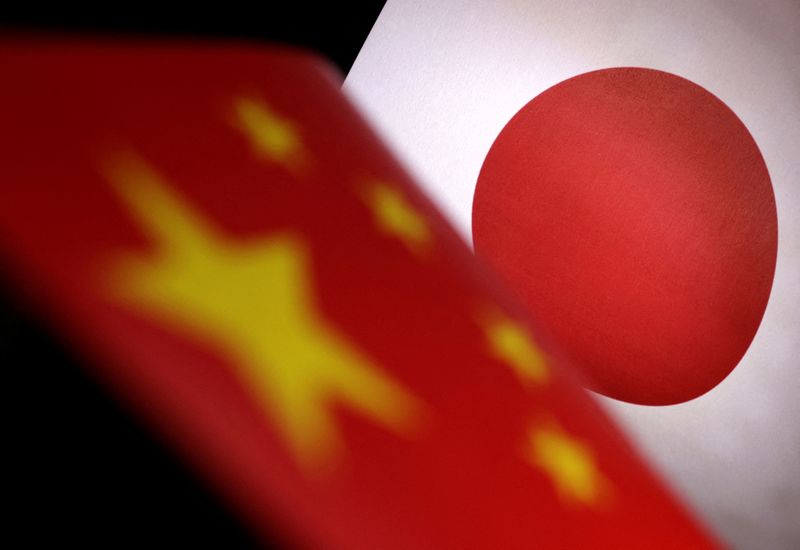
TOKYO, Dec 11 (Reuters) - Japanese companies said strained diplomatic relations with China are their primary concern as they head into 2026, followed closely by U.S. trade policies, a Reuters survey showed on Thursday.
Ties between the Asian neighbours have deteriorated since Japanese Prime Minister Sanae Takaichi told parliament last month that a hypothetical Chinese attack on democratically governed Taiwan could trigger a Japanese military response.
Asked what makes companies most concerned when forecasting business conditions next year, a quarter of survey respondents chose ties with China, while 22% picked U.S. trade policies.
China, along with the United States, is a leading trading partner and key supplier of rare earths used in areas as varied as autos, consumer electronics and defence.
Deterioration in relations was on full display when Japan on Sunday said Chinese fighter jets had aimed radar at Japanese military aircraft - an account China disputed.
The survey also showed 40% of companies expect earnings growth in the business year starting April 1, driven by factors such as progress in passing on costs and robust chip demand.
About 33% of respondents see single-digit earnings gain next year while 7% forecast a double-digit jump.
That compared with 14% that project an on-year decline and 46% who expect earnings to be largely unchanged.
"The cost of labour and other expenses are rising, but passing on costs through prices has enabled us to secure profit," a manager at a transportation firm wrote in the survey.
Multiple electronics manufacturers cited robust semiconductor demand for their bullish outlook.
Industry group World Semiconductor Trade Statistics expects the global chip market, driven by artificial intelligence-related demand, to grow more than 26% to $975 billion in 2026.
The poll was conducted by Nikkei Research for Reuters from November 26 through December 5. Nikkei Research reached out to 494 companies of which 236 responded on condition of anonymity.
PRIME MINISTER'S SPENDING MOVE WINS APPROVAL
Two-thirds of respondents welcomed the prime minister's plan to drop the annual primary budget balance as a fiscal consolidation goal, saying the decision was appropriate.
Takaichi said she will work on setting a fiscal target encompassing several years to allow more flexible spending, essentially watering down a commitment to fiscal consolidation.
The primary budget balance, which excludes new bond sales and debt-servicing costs, is a key gauge of how much policy measures can be financed without issuing debt.
"Although we might see interest rates go up as a result, we would welcome the possibility of it creating a flow of funds to necessary investment," said an official at a non-ferrous metal company.
With debt at more than twice the size of the economy, Japan is widely viewed as needing to fix its public finances.
On the yen, 55% of respondents expect the currency to trade at 150 to 160 yen to the U.S. dollar next year, while 41% expect it to be firmer at 140 to 150 yen.
(Reporting by Kiyoshi Takenaka; Editing by Christopher Cushing)
 ABC News
 CNN
CNN Raw Story
 Associated Press Top News
 AlterNet
 Mediaite
 Post Register