

 The Atlantic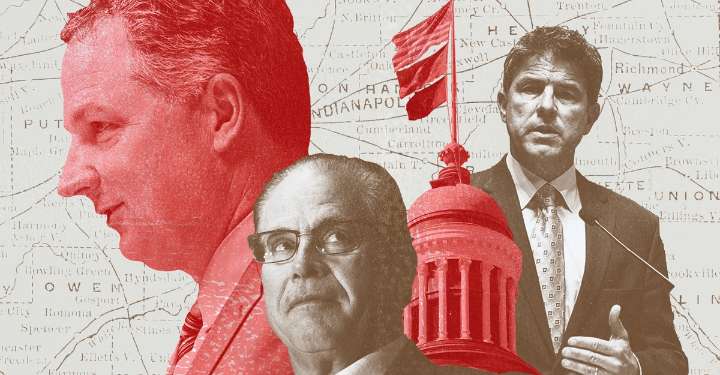
The Indiana legislature does not keep its constituents at a great distance. As lawmakers convened in Indianapolis on Monday to consider a bill backed by President Donald Trump to redraw the state’s congressional map, all that separated them from protesters who had gathered in a corridor just outside the capitol chamber was a series of glass windows. Inside the room, chants of “Just vote no!” and “We want fair maps!” could be heard as clearly as the legislative debate.
In an era when politicians typically operate at arm’s length from their voters, the public’s easy access to elected representatives is refreshing. In Indiana this week, it’s also a bit jarring. The state Senate is meeting under threat. Trump and his allies have vowed to target Republican lawmakers who vote against a redistricting plan that could wipe out the state’s Democratic congressional representation, protecting the U.S. House GOP majority. Over the past several weeks, Republican state legislators have faced a wave of “swatting” incidents, bomb threats, and other anonymous acts of intimidation, leading some to worry about their personal safety. The current climate of fear in Indiana, lawmakers in both parties told me, is without modern precedent in the state.
“We can have an argument and still be nice,” Mike Gaskill, the Republican chair of the senate’s elections committee, said as he opened a hearing on the redistricting bill. It was a plea as much as a declaration.
Indiana Republicans have been targeted because a number of them have done something that few others in the party, either in Washington, D.C., or in state capitals across the country, have dared to do: They have stood up to Trump. The administration launched its redistricting campaign over the summer in Texas, where GOP legislators quickly signed on to a plan to gerrymander the state’s congressional map to flip as many as five Democratic U.S. House seats. Republicans in Missouri and North Carolina acceded to similar White House demands.
In Indiana, the GOP holds the governorship and a supermajority in both chambers of the legislature. But from the outset, Republicans in the state Senate have resisted the president’s push. Two visits from Vice President J. D. Vance failed to secure enough support, and last month, the Senate voted to reject Governor Mike Braun’s call to hold a special session this month to consider a redistricting proposal.
Under intense pressure from the White House—Trump has singled out Indiana legislators by name in Truth Social posts—the state Senate president pro tempore, Rodric Bray, reversed course shortly before Thanksgiving and announced that the chamber would return to Indianapolis this week to consider a redistricting bill passed by the state House. Whether the president’s threats of retribution ultimately succeed should become clear today, when the Indiana Senate holds a final vote on a new congressional map drawn to give Republicans all nine seats—they currently hold seven—in the state’s U.S. House delegation.
The outcome is a mystery even to the highest-ranking Republicans in Indiana. Senators whose votes could be decisive have kept quiet, seeking to buy as much time as possible and avoid making themselves the target of even more harassment. When the elections committee approved the bill on Monday, teeing it up for today’s floor vote, three of the Republicans who supported the proposed map cautioned that they were pushing it forward only “for additional vetting” and that they could change their minds. “I’m going to continue listening to my constituents,” one of those Republicans, Linda Rogers, told me afterward. She said public opinion in her district, along the state’s northern border, was split “pretty equal” between supporters and opponents. Top Republicans in Washington, including House Speaker Mike Johnson and James Blair, the White House deputy chief of staff, have been calling and texting Indiana holdouts this week in hopes of flipping their votes.
The committee vote followed a marathon hearing in which senators heard four hours of testimony from more than 100 members of the public, the large majority of whom urged Republicans to stand strong and defeat the redistricting bill. “It’s not just politics. It’s a calculated assault on fair representation,” Ethan Hatcher, a local radio host who said that he voted for Trump in each of the past two presidential elections, told the committee as cheers erupted from the demonstrators listening outside the chamber.
In the hearing’s closing moments, Senator Greg Walker, a Republican, described the harassment he received after declaring his early opposition to redistricting, including an unsolicited pizza delivery and a separate incident in which heavily armed police responded to a false emergency call to his home. He said he was fortunate, because unlike other Republicans subjected to such swatting attempts, he did not have small children who might have been traumatized by the scene. “I refuse to be intimidated,” Walker said, reaffirming his intent to vote no. Through tears, he described having held a friend’s newborn the night before and worrying about the world the child would inherit. “I fear for this institution,” Walker said. “I fear for the state of Indiana. And I fear for all states if we allow threats and intimidation to become the norm.”
Over the past few days, I’ve asked both Republicans and Democrats here to explain why Indiana has become the new hotbed of GOP resistance to Trump. It is not the only state to rebuff the president’s redistricting demands; Kansas Republicans also have been unable to muster the votes for gerrymandering, and success in Florida is not assured. But no state has faced the White House–directed onslaught that Indiana has.
I received several answers. Most, however, said that the push for mid-decade redistricting simply ran afoul of the small-c conservatism on which many Indiana Republican legislators still pride themselves. “Midwesterners being midwestern,” one anti-redistricting advocate replied with a shrug outside the senate chamber. Republicans told me that state Senate opponents of redrawing the maps tended to be more institutionalist than MAGA, echoing a divide that still crops up among the party’s lawmakers in Washington. “I’m such a rule follower, it’s not even funny,” Walker said during his committee speech on Monday.
Democrats told me that many Republican senators in Indiana remained far more pragmatic than their counterparts in Congress have become during the Trump era. In this, they have more in common with Indiana Republicans from an earlier era, such as former Governor Mitch Daniels (a public opponent of redistricting) and the late Senator Richard Lugar, who was known for his friendship with President Barack Obama. Senators have clashed with Republican governors (including former Vice President Mike Pence) over other national flash-point issues such as abortion and gay rights. Most of what they debate, however, draws little interest from the president and his allies. “A lot of these people are not die-hard partisans,” Nick Roberts, a 25-year-old member of the Indianapolis city council, told me. Roberts has spoken out against the redistricting plan and is the only Democrat known to have received threats as a result.
The debate on Monday was notably more collegial than the acrimonious exchanges that have proliferated in Congress. Democrats are largely powerless in the Indiana legislature, holding just 10 out of the senate’s 50 seats. But they effusively praised Gaskill, a redistricting supporter and staunch Trump backer, for his handling of the hearing even as they encouraged their colleagues to continue bucking the president. “He does not care about Republicans in Indiana. He does not care about Republican senators,” Senator Fady Qaddoura, a Democrat representing part of Indianapolis, said of Trump during the hearing. “And if you stand in his way, he will destroy you.” Then he said to Republicans: “I pray for you. I pray for your safety.”
 ABC News
 CNN
CNN AlterNet
 Raw Story
 Associated Press Top News