

 The Atlantic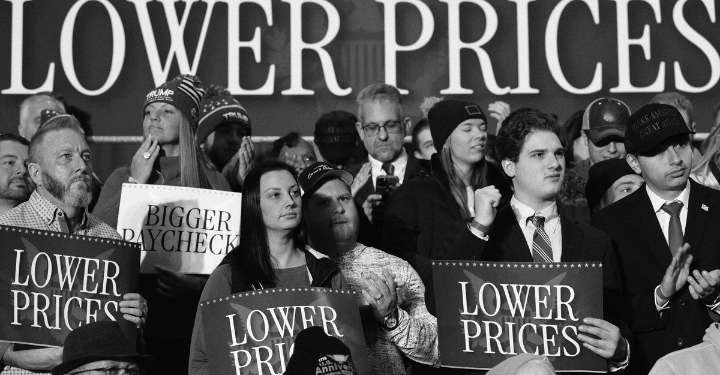
During last year’s presidential campaign, Donald Trump coined a term for his pinballing speaking style—“the weave.” This was on display Tuesday in Pennsylvania, in remarks that included, but were not limited to, the topics of tariffs, U.S. Steel, fracking, wind turbines, electric-vehicle mandates, immigration, crime, gender policies, Obamacare, the Fed, his election victories, rare-earth negotiations, a D.C. terror attack, and “the lips that don’t stop” of White House Press Secretary Karoline Leavitt.
The diffuse pattern is Trump’s signature. His fans have always loved it when he lights up all the bumpers; the chaos feels authentic, a rebellion against teleprompter politicians. This was true in Pennsylvania. The problem is, now that the engine of the U.S. economy is smoking, the American people are looking for a technician, not an improv comic. And Trump’s sprawling delivery doesn’t just distract from his economic message; it embodies the criticism he’s trying to rebut—that he isn’t focused on the issue that voters care about the most.
The president is hitting a wall of resentment. In a recent Politico poll, nearly half of voters—including 37 percent of Trump’s own 2024 coalition—said that the cost of living is the “worst they can ever remember.” That perceived reality is dragging his numbers down across the board: Only 31 percent of U.S. adults now approve of how Trump is handling the economy, a new AP/NORC poll found, down from 40 percent in March. It’s the lowest economic approval that AP/NORC has registered in either of Trump’s two terms. In a recent CBS News/YouGov survey, a majority of respondents said that his policies are driving up food and grocery prices.
Historically, presidents have responded to economic discontent with focus, and a concerted display of that focus. Franklin D. Roosevelt passed 15 major bills in 100 days. Ronald Reagan, in the teeth of double-digit unemployment, pushed for sweeping tax cuts week after week. Bill Clinton built an economic “war room” before he even took office, and his team introduced what has now become a political cliché: focusing “like a laser beam” on the economy. Barack Obama instituted a morning economic briefing that put the issue on par with national security. Each practiced the same principle: If you can’t solve the problem fast, at least get caught trying.
[Derek Thompson: The affordability curse]
Trump is now trying. Kind of. The White House presented Tuesday’s event as the kickoff of an “affordability tour” designed to reassure voters ahead of the 2026 midterms. But although the president acknowledged that prices are high, he seemed grumpy about the whole exercise of having to explain himself. “They always have a hoax,” he said on Tuesday, referring to Democrats. “The new word is affordability. So they look at the camera, and they say, ‘This election is all about affordability.’” The president’s most focused message on affordability is that affordability concerns are a hoax. He used that word, or an equivalent, several times on Tuesday, as he has in Oval Office remarks, in a Cabinet meeting, and on social media.
Instead of confronting and sympathizing with voters’ concerns, the president seems to think that all he needs to do to override their current pain is reacquaint people with their negative feelings about the economy under Joe Biden. The former president tried his own version of this before he dropped out of the presidential race last year: remind people of what they disapproved of in Trump’s first term, and hope they’ll recoil afresh. But Trump convinced voters to trust their present feelings over their past concerns.
Tuesday, in Philadelphia, the president focused on the past: “They gave you high prices. They give you the highest inflation in history. And we’re giving you—we’re bringing those prices down rapidly,” he continued. “We’re getting inflation. We’re crushing it, and you’re getting much higher wages.”
The data tell a less binary story. Inflation under Biden was high, at 9 percent, but not the 12 to 15 percent of the 1970s and early ’80s. When Biden left office, it was 3 percent, about the same as it is now. Trump’s own tariff policies are raising prices for consumers, undermining his claim that he is bringing costs down, while also eating away at the increase in wages in his second term. And according to an analysis of data from the Atlanta Fed, wages are growing faster than inflation for a little more than half of the workforce, which is why many people might not feel better off.
The economy hasn’t collapsed under Trump’s tariff plan, as many predicted. Unemployment remains low, the stock market is strong, and jobs are being created. The problem is that these aggregate gains mask uneven distribution, and many workers really are seeing their purchasing power erode.
Trump is hardly the first president to cherry-pick numbers and accentuate the positive. But his argument is weak because he has to overcome people’s lived experience. To win back voters’ approval on this issue, he not only has to show that he can turn around an economy—nearly impossible for any president—but also has to reverse the laws of politics that say the bank account and wallet outweigh presidential rhetoric. That is an unavoidable truth, no matter how hard you weave.

 CNN
CNN Associated Press US News
 ABC News
 Raw Story
 AlterNet
 Live 5 News Crime
 The List
 People Top Story