

 Reuters US Economy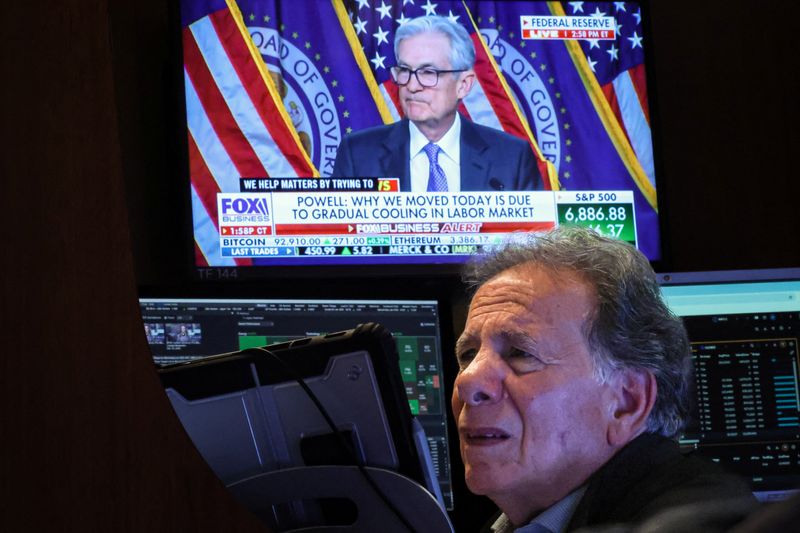
ORLANDO, Florida, Dec 10 (Reuters) - The dollar sank and Wall Street rallied on Wednesday, with the small-cap Russell 2000 index surging to new highs, after the Fed cut interest rates and Chair Jerome Powell offered a positive outlook on the path for growth and inflation.
More on that below. In my column today, I look at how the global interest rate landscape is suddenly looking a lot more hawkish, and therefore potentially more volatile for investors. The global easing cycle is over.
If you have more time to read, here are a few articles I recommend to help you make sense of what happened in markets today.
1. Divided Fed lowers rates, signals pause and one 2026 cutas growth rebounds 2. Bank of Canada holds rates, says economy is resilient 3. China's deflationary strains persist even as consumerinflation hits 21-month high 4. ECB may lift growth outlook again, Lagarde says 5. AI masking the economy cuts both ways: Mike Dolan
Today's Key Market Moves
* STOCKS: Wall Street rallies strongly - Russell 2000outperforms, Nasdaq lags. * SECTORS/SHARES: Industrials, materials +1.8%. Onlysector to fall is utilities, and only 0.1%. GE Vernova +15%,Warner Bros +4.5%. Uber -5.5%, Microsoft -2.8% * FX: Dollar falls broadly, down around 0.6%-0.8% vs CHF,EUR, NZD. Brazil real -1%. * BONDS: U.S. Treasury yields fall, as much as 7 bps atthe short end, bull steepening the curve. * COMMODITIES/METALS: Oil +1%, gold +0.5%, silver +1.5% tonew high $61.74/oz.
Today's Talking Points
* Fed gets to neutral
The Fed cut interest rates by 25 basis points on Wednesday, and Powell said policy is now broadly in neutral territory, meaning policymakers are "well-positioned to wait and see how the economy evolves from here."
Powell was bullish on growth, productivity, and the Fed's ability to get inflation back down to the 2% target. Markets liked what they heard, with Wall Street rallying and the Russell 2000 zooming to a new record high.
* Emerging market inflation signals
China and Brazil released their latest inflation figures on Wednesday, and the signals were mixed. China's consumer inflation popped up to a 21-month high but producer deflation remained entrenched, while consumer inflation in Brazil slowed to its lowest in over a year.
China's yuan edged to a new 14-month high against the dollar, while Brazil's real was one of the world's worst-performing currencies on Wednesday. Chinese bond yields fell, while Brazil's rose.
* You got the silver
Silver is cementing its place as one of the world's best-performing assets of 2025, leaping even higher this week to new records above $60 an ounce. It is now up 110% this year, nearly double gold's rise.
Can it continue? As investors close their books at year end, profit-taking should kick in. But momentum is strong, technicals are positive, and demand/supply dynamics look bullish - the silver market is a fraction of the $30 trillion gold market, and if investors want more exposure to alternative assets, relative demand looks pretty powerful.
Global central bank easing cycle is over
The global interest rate landscape is suddenly looking a lot less benign than it did only a few weeks ago, suggesting 2026 could be much more volatile than investors had bargained for.
Comments this week from Reserve Bank of Australia Governor Michele Bullock and European Central Bank Board Member Isabel Schnabel, signaling that their next move could be rate hikes, have brought into sharp focus the hawkish drift across major central banks that has emerged recently.
Bullock's remarks caught markets off guard, while Schnabel's were less surprising. But together, they underscore a much more challenging monetary policy environment next year - borrowing costs are likely to rise.
The common thread is inflation, which remains stubbornly above target in many developed economies, while growth is still mostly solid.
The question now is whether Federal Reserve Chair Jerome Powell will send similar signals on Wednesday with a so-called "hawkish cut" – a drop in interest rates coupled with tighter guidance.
HAWKISH PIVOT
A glance at market rate expectations for G10 central banks shows that only three - the Fed, Bank of England, and Norges Bank - are expected to cut rates next year, with the Fed easing by 75 basis points and the other two by 50.
The Bank of Canada and RBA are now expected to raise rates by around 35 and 50 bps next year, respectively. Only a few weeks ago rate cuts in both countries were considered more likely than hikes.
What explains the turnaround?
Many major central banks are in a highly unusual position, having just conducted the fastest rate-cutting cycle outside a recession in decades. In the case of the Fed, it's since the mid-1980s, while the ECB has never eased policy this aggressively absent a contraction, according to Deutsche Bank analysts.
History shows that, unsurprisingly, rapid easing without a recession often leads to a strong re-acceleration of economic activity, especially if the rate cuts are coupled with fiscal largesse, paving the way for a quicker-than-expected return to rate hikes. This may be what we see next year.
"Central banks are very much walking a tightrope right now," Deutsche Bank's Jim Reid wrote on Tuesday.
Of course, the chances of the Fed raising rates any time soon are low. But given the way the international wind is blowing, it's not something that can be completely taken off the 2026 table, Reid says.
UPENDING MARKET COMPLACENCY
As investors reassess the global central bank landscape, currencies and bonds could be particularly vulnerable, especially with volatility in these markets so muted at the moment.
The "MOVE" index, a measure of implied volatility in the U.S. Treasury market, last week fell to a four-year low, while this week an index of implied volatility across six major currencies against the U.S. dollar hit its lowest since July last year.
One likely implication of a hawkish lurch across G10 central banks is renewed selling pressure on the Japanese yen.
The consensus market view has long been that the Bank of Japan will hike rates in 2026, but the expectation was that few of its G10 counterparts would follow suit, helping to prop up the flagging currency.
A hawkish global pivot would complicate policy for the BOJ significantly and risk sending the yen back to recent historic lows around 162 per dollar, raising the specter of FX market intervention by the Ministry of Finance. It's not far from that level today.
Another potential consequence is emerging market currency weakness. That's because, all else being equal, if rates are rising globally, investors will be drawn to the safety and increasingly tempting returns of currencies in developed economies.
Meanwhile, many bond markets around the world have begun to get jittery, led, once again, by Japan. Heavy selling in Japanese government bonds (JGBs) has caused long-dated yields to leap to historic highs.
But JGBs are not alone. Australia's 10-year yield is up 70 basis points since late October, Germany's 30-year yield hit a 14-year high on Tuesday, and Canada's 10-year yield is up 35 basis points in a little over a week.
As this year draws to a close, there's something of a paradox in currency and bond markets. Investors are nervy, but volatility is low. The prospect of a global hiking cycle next year may soon sort that out.
What could move markets tomorrow?
* Australia unemployment (November) * Japan 20-year government bond auction * Philippines interest rate decision * Switzerland interest rate decision * Turkey interest rate decision * Canada trade (September) * U.S. Treasury auctions $22 billion of 30-year bonds * U.S. weekly jobless claims * U.S. trade (September)
Want to receive Trading Day in your inbox every weekday morning? Sign up for my newsletter here.
Opinions expressed are those of the author. They do not reflect the views of Reuters News, which, under the Trust Principles, is committed to integrity, independence, and freedom from bias.
(By Jamie McGeever; Editing by Nia Williams)

 The Motley Fool
 CBS News
 The Daily Sentinel
 NECN Providence
 WMBD-Radio
 Reuters US Business
 CNBC Stock Market
 AlterNet